


Keeping the UTP Cat in the Bag
The unsung hero of the digital information age is the Unshielded Twisted Pair (UTP) cable.

23 July 2008
Text:/ Andy Ciddor
Hundreds of thousands of kilometres of blue string link every part of our lives and homes and installations and offices and venues and gigs; carrying the data that has transformed our industry and the world.
A bandwidth of 100MHz makes Category 5e UTP a comfortable fit for a vast range of applications, including of course the 10Base-T (10Mbps over Twisted pair) and 100Base-T (100Mbps over Twisted pair) ethernet whose proliferation has made it the cheap commodity data cable that you can pick up in any electrical wholesaler, hardware store, technology store or computer shop across the country.
Used in combination with the right flavour of balun or a couple of boxes of simple electronics, we can shoehorn pretty much any signal we fancy down a Cat5e line. Analogue audio, AES/EBU digital audio, composite video, S-video, RGB, VGA, CATV, CCTV + PTZ, DVI, MIDI, DMX512, KVM, EIA (RS)-232/422/485, ISDN, PSTN, all make it through UTP unscathed.
What makes a bundle of four unshielded twisted pairs of pretty ordinary cable capable of safely carrying signals at such high frequencies is the power of the twist? By twisting the wires in a pair very tightly together, any external signal that intrudes into the data on the pair is usually picked up equally by both wires and self cancels due to the balanced line signal in the pair (common mode rejection).

The elliptical structure developed by ADC Krone for its Cat6A offering: CopperTen.
WHEN THE GOING GETS TOUGHER….
Using different rates of twist in each of the four pairs reduces the coupling between pairs and thus the level of crosstalk between them. This has the side effect of making the pairs of cables slightly different lengths and introduces data skew between the pairs due to signals arriving at the far end at slightly different times. Whilst most high-speed ethernet interfaces automatically compensate for the skew, it can present as a problem when component video is carried over long runs of UTP. The more sophisticated component video (RGB, VGA, S-video, etc) to UTP interfaces include some form of skew compensation.
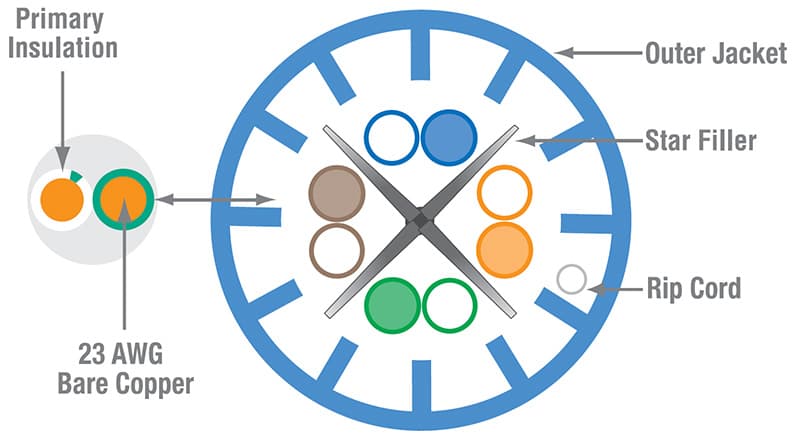
At high signal frequencies, where crosstalk between the pairs becomes a serious concern, a plastic filler is inserted in the centre of the cable to keep the pairs further apart and thereby reduce the strength of the crosstalk signals. Smart network interface electronics can also remove the elements of the signal that are recognised as having crossed over from another pair.
Separating the pairs puts them closer to the jacket of the cable and thus makes them more prone to picking up crosstalk from adjacent cables in a UTP bundle. This has led to the use of a range of treatments to the outer sheathing of the cable to reduce this so-called alien crosstalk. Some approaches introduce internal ribbing and similar structural features into the sheath to keep the twisted pairs away from the walls, while others involve using materials of higher dielectric strength to reduce the permeability of the outer sheath. As the network interface electronics know nothing about the content of alien crosstalk, filtering electronics are of little use in solving this problem.
THE CAT’S TALE
Right now, Cat5 and its higher speed replacement Cat5e UTP are perfectly adequate for the majority of our data needs, serving us well for both analogue signals and our LAN requirements for 10Mbps and 100Mbps data. The different twist rates in Category 5e even make it suitable for the more demanding requirements of the 1000Base-T specification for Gigabit Ethernet — a standard that is becoming more common in video production and processing environments, and for connections to data servers and archiving systems.
If you’re engaged in audiovisual production in any of its guises, there is little doubt the most cost effective and capable UTP cable in use today is Cat5e. However, the story is very different if you’re involved in the selection and specification of data cable for installed systems. Our clients expect us to give them the best possible advice on what is most suitable for their current needs, while also rendering them future proof. Category 5e UTP is not the answer and neither is the more capable Category 6 UTP with its plastic separator and its 250MHz bandwidth.
“”
We have been shown the future brothers and sisters
The ribbed structure developed by Hitachi Cable Manchester for its version of Cat6A.
LOOK WHAT THE CAT DRAGGED IN
We have been shown the future brothers and sisters, and while it’s not certain whether the rocket cars we will all be driving will be manufactured by Boeing or Nintendo, it is abundantly clear that vast amounts of high resolution video data will be moving around in real-time between storage arrays, workstations and display systems. The next step down the shining path to that glorious future will be Local Area Networks (LANs) moving data around at 10 Gigabits per second.
Initially, there were serious concerns that it wouldn’t be possible to reliably move 10Gbps data over commodity UTP cable due to the problem of alien crosstalk. This pointed to relying on the more expensive alternative of optical fibre or complex cable types such as Category 7 (each pair screened and the entire cable shielded).
After considerable discussion and experimentation a 10GBase-T standard was defined in mid 2006, and, within a year, network interfaces were available at that speed, albeit at thousands of dollars per port. The only UTP cable that could meet the requirements of the standard was Category 6, but it was only suitable for runs up to 55m; not the 100m that is the norm for LANs. Work commenced on a standard for a cable that could carry 10Gbps over a full 100m, and several examples of such cables were put forward by manufacturers to demonstrate the techniques that could be employed to reduce alien crosstalk. Out of this arose the augmented Category 6 or Category 6A standard that was approved and ratified just a few months ago.
CAT 6A NITTY GRITTY
Category 6A cable has a bandwidth of 500MHz and relies on what can best be described as a complex smoke and mirrors act of signal processing and error correction to pump the raw 18Gbps of data throughput necessary for a reliable 10Gbps data rate. The complex signal processing demands of the 10GBase-T standard mean that it will be some time before affordable 10Gbps network interfaces will feature on most equipment; a pattern seen previously with both 100Mbps and later 1Gbps interfaces.
Cable manufacturers have been waiting in the wings throughout the Category 6A standards process, ready to trot out the cables they have developed that will meet or exceed the new standard. The first couple of months of 2008 saw them lining up to announce cables with 600MHz and even 660MHz bandwidths that meet the standard with megabits to spare.
With 10Gbps networks firmly visible in the future and suitable UTP cable now available from a plethora of sources, the time has now come for us to consider specifying a cable that will cover our clients and our own requirements for at least another generation of network applications.












RESPONSES