
AV Case Study: Sofitel Melbourne LED Upgrade
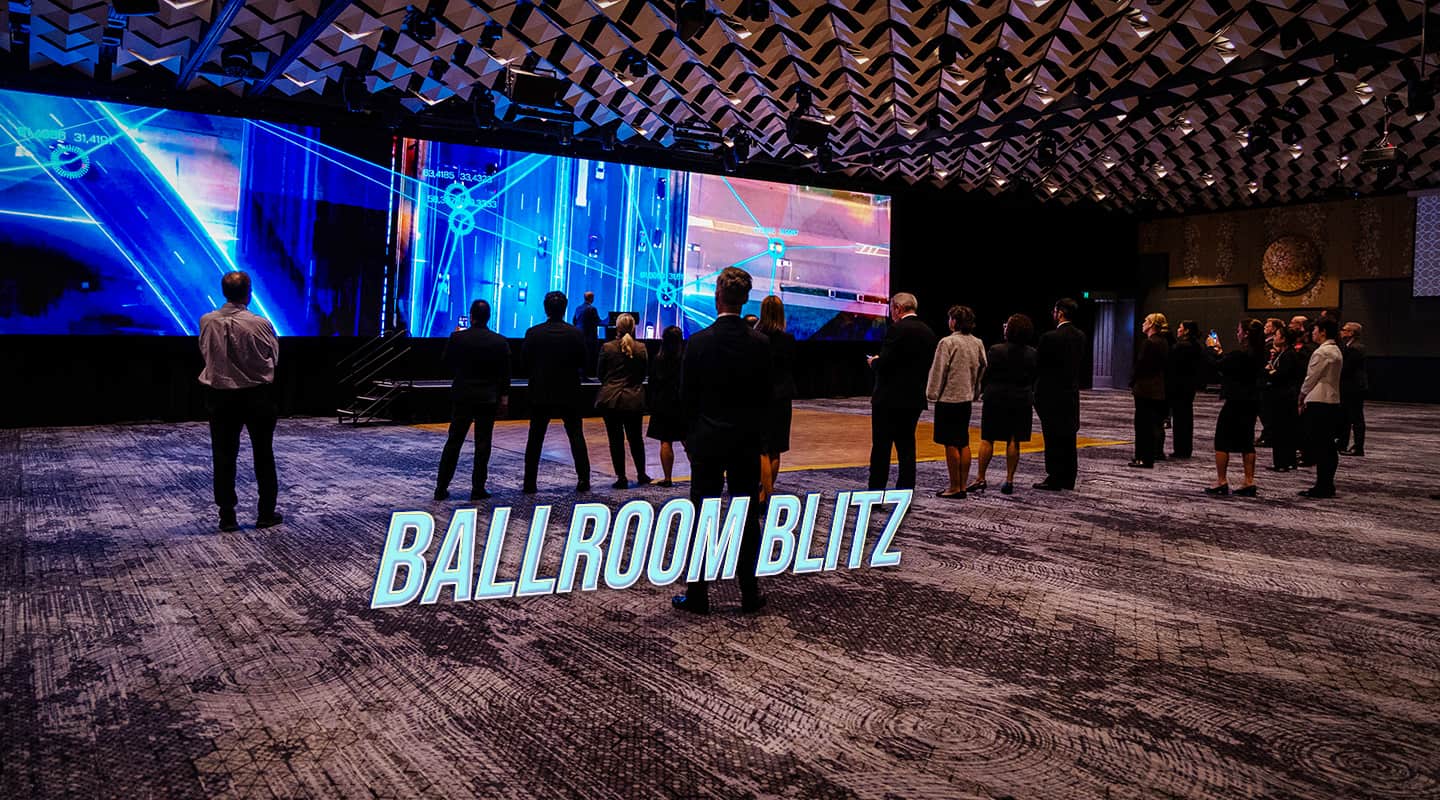
This 18m Absen LED is a versatile tech marvel thanks to some smart engineering.

20 May 2026
Hotel AV can sometimes feel like a thankless job. The client’s just spent a fortune booking events spaces from the hotel and now they’re being told they’ve got to fork out quite a bit more to spend on the technology to stage the event.
The client doesn’t care if you’ve just spent $20,000 on brand new digital wireless microphones or gee-whiz LED par cans – as crucial as those investments are – mostly they want to keep costs reasonable, plug in a laptop, and be seen and heard.
However, sometimes a tech investment does make the headlines. Sometimes a new AV purchase gains instant attention and approval from hotel management. Sometimes a piece of audiovisual infrastructure is so compelling that clients find more budget from behind the back of the couch to rent it, and helps to maximise the use of a desirable space. More than that, sometimes the technology in question is more than eye candy, it actually helps the tech team and the events team squeeze more out of desirable spaces.
This is just such a story. Spoiler alert: it’s more than just a big new LED.
LONG-TERM VISION
AV Manager, Justin Harris, has been with Audio Visual Dynamics (AVD) at Sofitel Melbourne for about 12 of the venue’s 20-plus years in-house. When the conversation turns to why Sofitel’s marquee venue, the Grand Ballroom, needed a serious upgrade, his answer is pragmatic.
“The way the industry is going made us think about what we need to do in this venue,” Justin explains. “AVD has been here for over 20 years, so it made sense to move towards LED technology – especially something flexible on a rail system, given that we have two removable walls that can change the room configuration.”
The plan wasn’t just one big screen. The new LED would be flexible and divisible. Anything from 3 x 6m-wide displays (when both operable walls are in place), up to one 18m-wide monster (in combined, full-room mode) with every permutation in between. This permanently-installed solution would require some serious engineering to allow for quick turnarounds of the space. We dive into all this shortly but before we do, let’s reflect on how things were (and often still are) routinely done.
FROM BLENDING TO ROLLING
Before the LED, the team relied on projection blending across large 20m surfaces. Justin doesn’t sugar-coat the old reality: clearing the floor, building a truss frame, raising the screen – it routinely needed eight people and many hours of grunt work and fiddly fine tuning. The result was a fixed super-widescreen with limited flexibility and that familiar ‘death by PowerPoint’ 16:9 look.
Meanwhile, the new setup is always there (or less than an hour to reconfigure), delivers picture-in-picture, movable elements, custom backdrops and better colour saturation than projection ever could. And, as all who had a hand in this project agreed, large-format screens – whether projection or ground-stacked LED – are simply becoming the norm for clients who want to impress their audience.
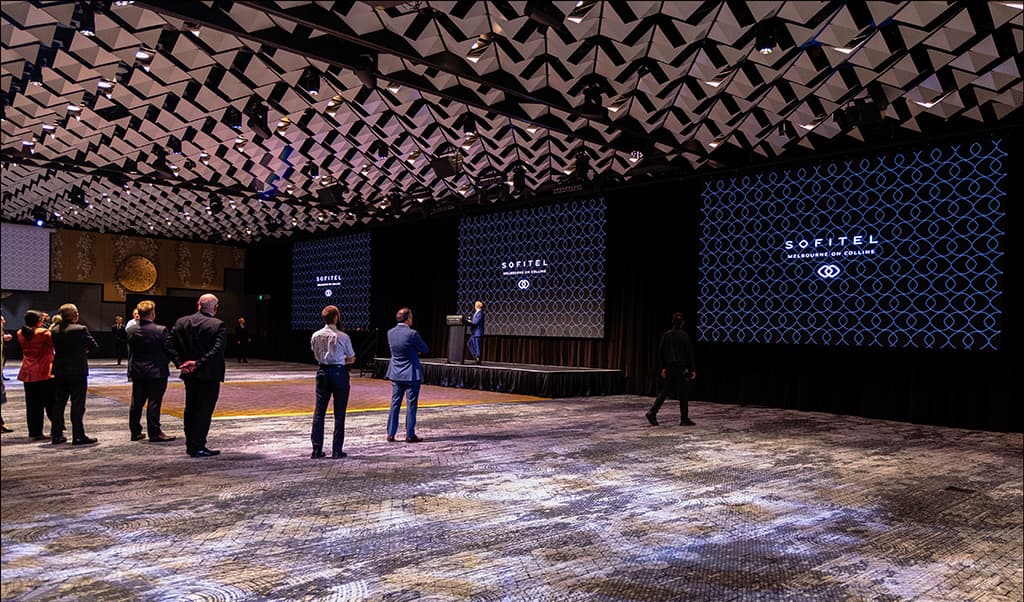
The system can reset from room combined mode to three separate 6m screens in under an hour.
CHOOSING THE RIGHT PANEL
NAS is an Absen distributor in Australia, and Tommy Blum as Technical Sales Manager steered the product conversation. Tommy observed that the Grand Ballroom is a dynamic space with constant resetting and action, so fixed-install panels weren’t going to cut it. Instead, they selected the Absen NT2.6 Pro V2 – a rental/production-grade panel with IMD 2-in-1 LED technology for improved durability (four times the thrust of conventional SMD), 2.6mm pixel pitch, 7680Hz refresh rate, 16-bit processing and vivid colour performance. Each individual panel is lightweight (around 10kg for the 500 x 1000mm versions) yet robust.
ENGINEERING THE MOVEMENT
Arguably, the real hero of this install is the mobility. Three screens totalling nearly 1.5 tonnes slide along a German-made monorail system. Michael Petrani led the engineering design and installation. Michael draws on an enormous amount of experience in rigging and custom solutions such as this.
“It’s a difficult space,” he says. The monorail track would need to be mounted to the ceiling and that was no easy task. Michael refers to the architectural ceiling, acoustic ceiling a metre above, then another 500mm to the concrete slab full of tendons and reinforcement bars you absolutely cannot drill into. Attachment points had to be minimal and smart.
The chosen track allows anchors every three to three-and-a-half metres – fewer than the more customary alternative. Each high-loading trolley can handle 500kg, with eight trolleys per screen. The result? Almost zero resistance.
“Once all three screens are together at one and a half tonnes, it only takes a small amount of effort to nudge them across the room,” Michael explains. The system is essentially an industrial gantry-crane design built for repeated heavy movement.
Removable ceiling track sections accommodate the operable walls, with physical stops for safety when sections are taken out. The entire engineering and approval process — including liaison with the venue’s own engineer – took about two-and-a-half months.
“”
it made sense to move towards LED technology – especially something flexible on a rail system
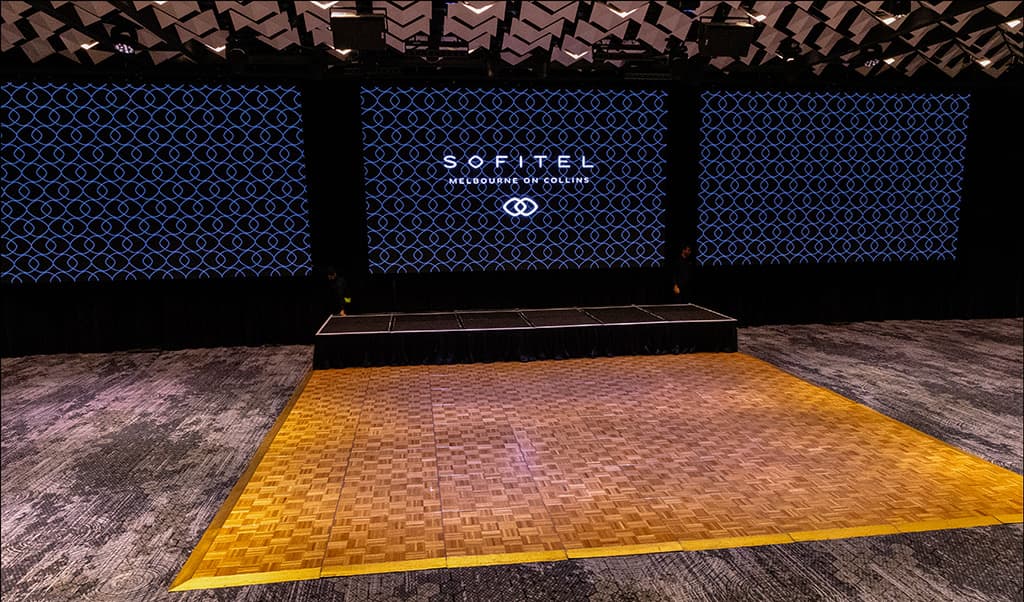
Even in room combined mode, the LED can divide to allow for three conventional 16:9 displays
RESET IN MINUTES
Operationally, the difference is night and day. Justin describes the reset process: change the cable loom hook-ups, slide the screens, install or remove rail pieces as needed, lock top and bottom to eliminate seams. Sliding and locking takes about 15 minutes; adding rail sections might stretch to 30-60 minutes depending on room conditions.
Back-end processing is equally streamlined. In Separate Room mode the Novastar H Series (H5 splicer) handles scaling and splitting using existing gear and patching. In Combined mode the Pixel Hue P20 manages the native full-screen resolution for backgrounds, layers and PIPs. Up to 12 presets cover every possible configuration, making it simple enough even for casual crew during peak periods – just load the preset for the current room state.
STRATEGIC INVESTMENT
From AVD’s perspective, this is more than a single-room upgrade. Justin sees it as keeping Sofitel in step with industry front-runners. Clients compare venues on roadshows, and a luxury hotel needs the best tools available. Word is already spreading within AVD’s other venues and across the tight-knit Melbourne hospitality scene.
Absen’s service sealed the deal: custom receiving cards (A10S Plus) for future-proofing, rapid delivery before Christmas, and a technician flown in post-install for fine-tuning greyscale, gamma and uniformity. It all served to impress.
Michael, who works with just about ever brand of screen, singles out the Absen panels for how cleanly they align – minimal gaps, excellent side-to-side pressure, and pins that line up with almost no effort even on a suspended track. “Even if it’s not your fault, alignment is what you’re judged on,” he notes. Here, it simply worked.
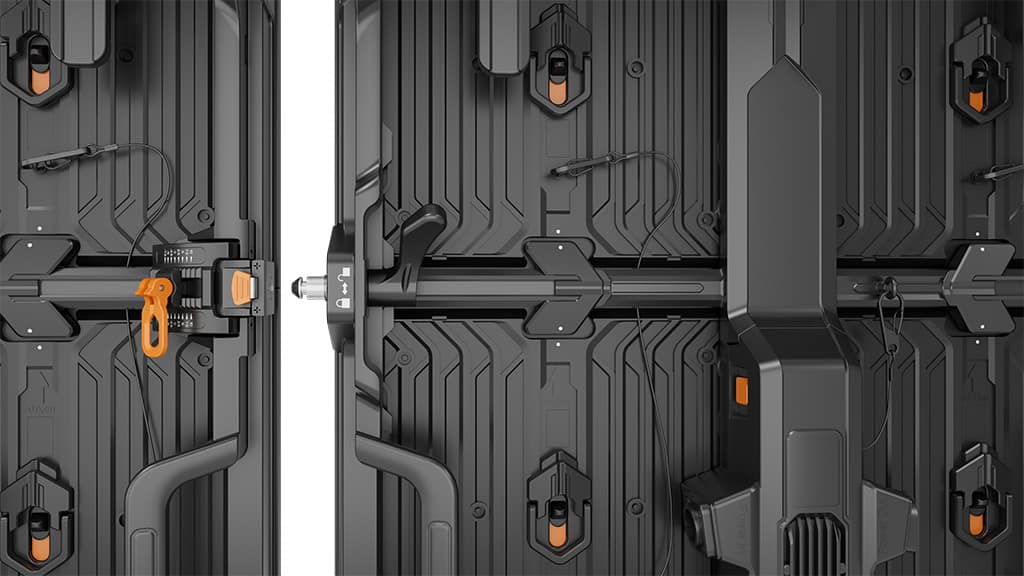
Absen’s NT2.6 Pro V2 provides rock-solid pin connection and inter-cabinet pressure.
MORE THAN EYE CANDY
The 18-metre Absen NT2.6 Pro V2 wall, married to the monorail and Novastar processing, has transformed the Grand Ballroom from a labour-intensive projection setup into a genuinely flexible, high-impact events space. It saves crew time, delights clients, impresses hotel management and gives AVD a competitive edge.
And, as Justin and the team are already discovering, it’s the kind of installation that pays dividends well beyond the ballroom.
Audio Visual Dynamics: avdynamics.com.au
Diversity Rigging: diversityrigging.com.au
NAS (Absen): nas.solutions





RESPONSES