
AV Case Study: Swinburne’s Virtual Universe
Swinburne’s Virtual Universe demonstrates what one man’s singular vision and the thoughtful integration of Absen LED, Q-SYS and Igloo Vision can achieve.

20 July 2026
Professor Matthew Bailes, Director of the Australian Research Council’s Centre of Excellence for Gravitational Wave Discovery and founder of Swinburne’s Astrophysics Group in the late 1990s, has long championed taking science to the people. More than that, he’s seen the power of immersive outreach for decades. From early polarised 3D projector theatres to an AstroTour mini-IMAX facility and subsequent VR experiments, his goal remained consistent: share authentic astrophysics with broad audiences, helping to instil an awe, and a faith in scientific discovery and rigour.
VR, however, presented barriers. “People get sick. You have no feedback as to whether they’re enjoying it or not when you’re engaging with them, you don’t even know if they’ve got their headset on properly,” Matthew explained. A colleague’s Cave II installation at Monash Uni – 80 displays in a bezel-heavy array driven by 20 computers – offered inspiration but remained a specialist research tool rather than an outreach asset. PowerPoint presentations for VIPs felt inadequate.
A tradeshow encounter changed everything. An LED screen displaying a vibrant chameleon caught Matthew’s eye. Follow-up showroom 3D shutter-glass trials amazed him: “I was just astonished at how vibrant the 3D was with LED compared to what I was used to, which was projectors where the 3D wasn’t very pure.” Robustness appealed too – modules could be swapped after impacts that would otherwise destroy an LCD. A 10sqm prototype proved to be a good proof of concept, ironing out eye-delay artefacts, and generating enthusiastic reactions. This paved the way (and funding) for the full Virtual Universe: a hybrid, multi-use space in a prominent location at Swinburne University of Technology’s principal Melbourne campus.
ABSEN COB: ‘ERE ‘ERE
Let’s get something straight: Swinburne’s Virtual Universe is no ordinary visualisation space. It is a hybrid, multi-use immersive environment where cutting-edge astrophysics meets flexible presentation, virtual production, and experiential events. At its heart sit three integrated AV platforms: Absen’s COB LED display, Q-SYS for DSP, control and video transport, and Igloo Vision’s software engine.
But first, the big screen:
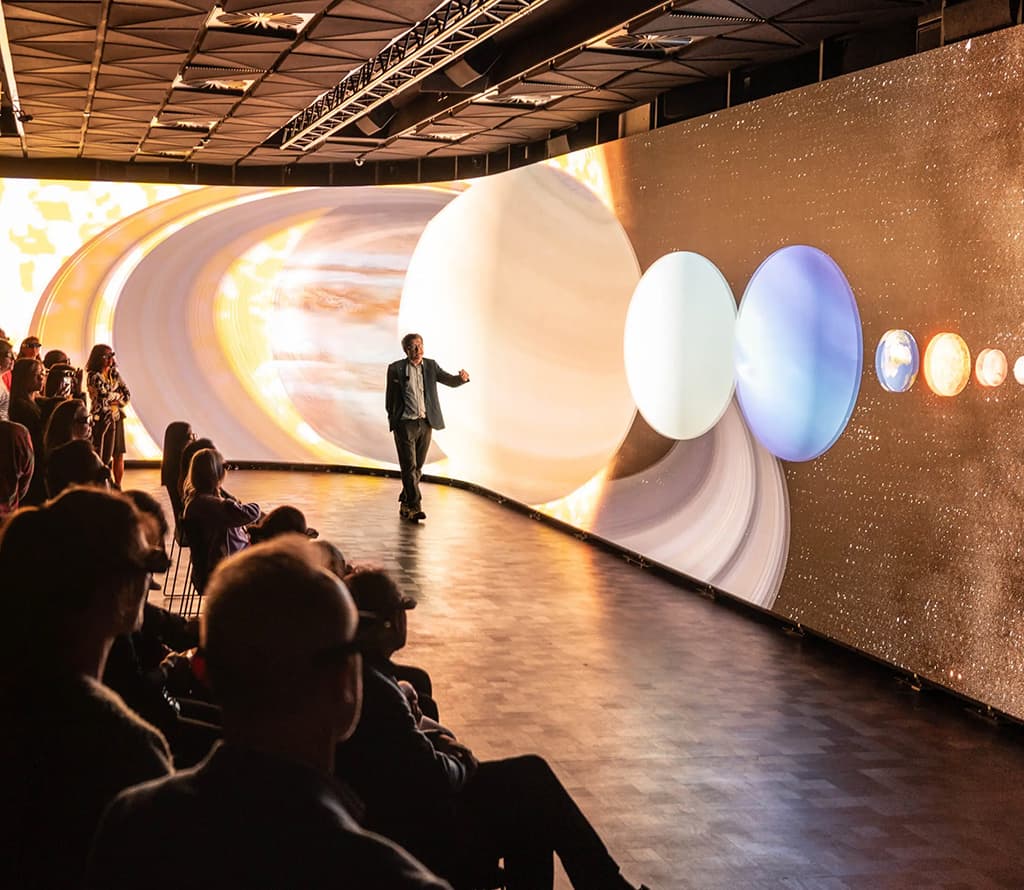
Professor Matthew Bailes strides the epic Virtual Universe ‘stage’.
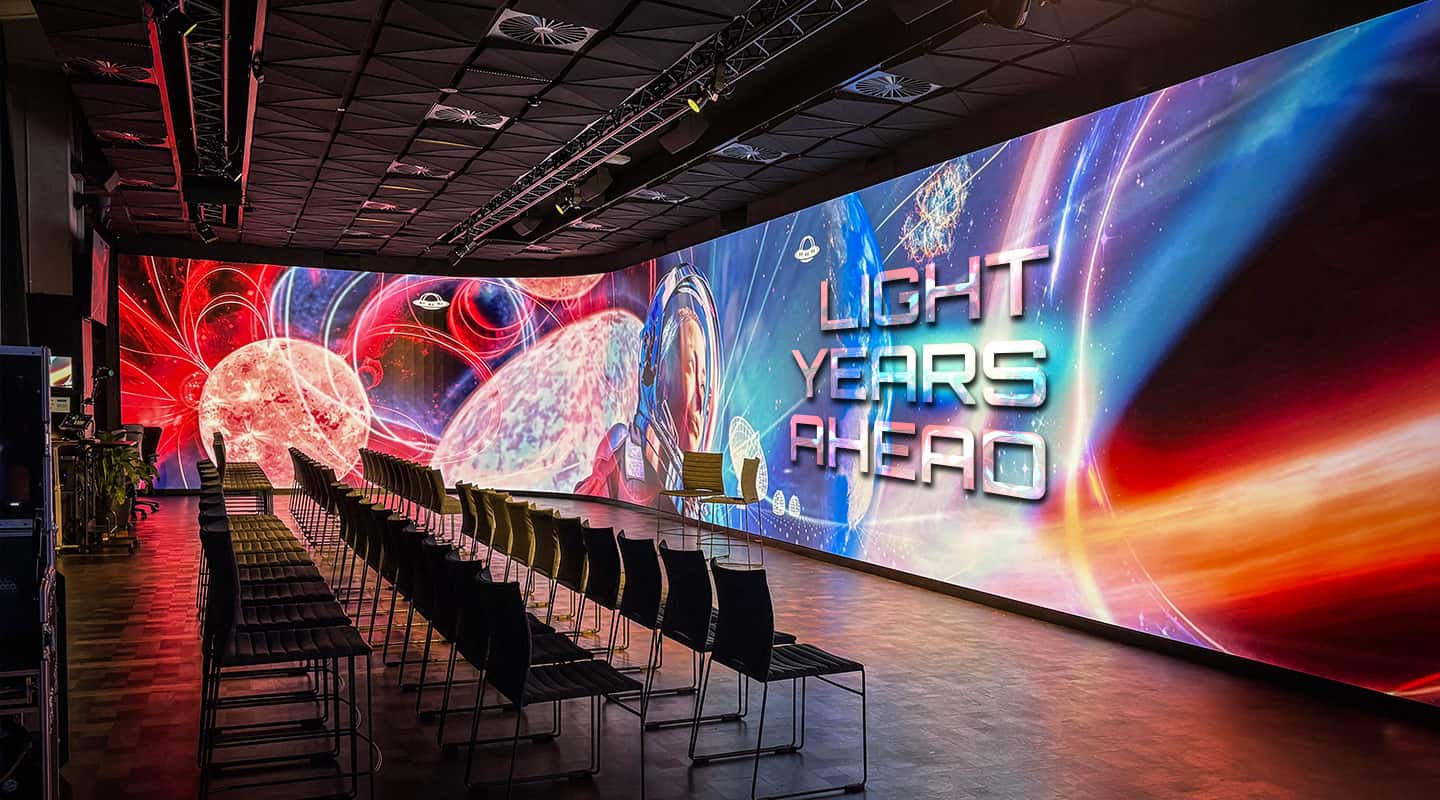
A panoramic shot of the 30m-wide Absen LED in presentation mode. Using the Igloo Vision Core engine the screen becomes a multipurpose display that can accommodate a variety of inputs and PIPs.
The installation showstopper is the 30m-wide Absen COB LED wall with 1.56mm pixel pitch (supplied by Quantum Sphere). The main surface plus wraparound wings create a partially immersive canvas running at roughly 20,000 pixels wide and 2160 pixels high, delivering around 45 million pixels total. The system targets 60Hz per eye with precise shutter-glass timing, high grey-bit depth, scan rates and refresh rates.
High contrast is a non-negotiable for astronomy content. “For too long when we’ve been displaying our content, blacks have been greys and that just takes a little bit of the magic away,” Matthew noted. COB technology achieves deep blacks and vibrant colour that withstand 3D glasses attenuating approximately 70% of light. The screen’s brightness sits at around 60% to avoid trips to the opthalmologist while preserving impact. When curtains close and lights dim, star fields resemble genuine points of light. Planets and moons cast realistic illumination across the room. “Suddenly Saturn just appears in your peripheral vision and you realise you’re being lit up by this planet… it’s magical,” Matthew enthused.
As Matthew just alluded to, the wings enhance the 3D magic. Objects maintain coherence as they move off the main wall, avoiding the left-eye/right-eye mismatch common in flat screens. Rendering objects requires care – spheres near curves can distort for off-axis viewers – but the perceptual benefit is undeniable. “It really makes it magical. We live in a 3D world, so we’re used to as humans having vision everywhere,” Matthew added.
Virtual production (one of the foreseeable alternative applications of the space) demands added complexity. Scan rates, grey levels and refresh characteristics ensure clean camera capture without artefacts. The NovaStar video processor supports these dual-use requirements alongside superior colour control and 10-bit processing. The 1.56mm pixel pitch balanced cost, power consumption, heat, and visual acuity; graphics cards align naturally with 2160-pixel vertical resolution. From seated viewing distances, individual pixels vanish.
Factory acceptance testing at Absen’s Shenzhen manufacturing plant ‘de-risked’ the project. Matthew, Carl Knox, and James Sheridan travelled with computers and content. “The main thing that kept me awake at night: was the 3D going to work or not?” Matthew recalled. “Seeing the 3D content – crisp and perfect – in the factory allowed me to proceed with confidence.” Custom LED panel runs addressed specific grayscale, black level and virtual production needs. Absen’s responsiveness helped push boundaries that standard solutions might not have met.
“”
Suddenly Saturn just appears in your peripheral vision and you realise you’re being lit up by this planet… it’s magical
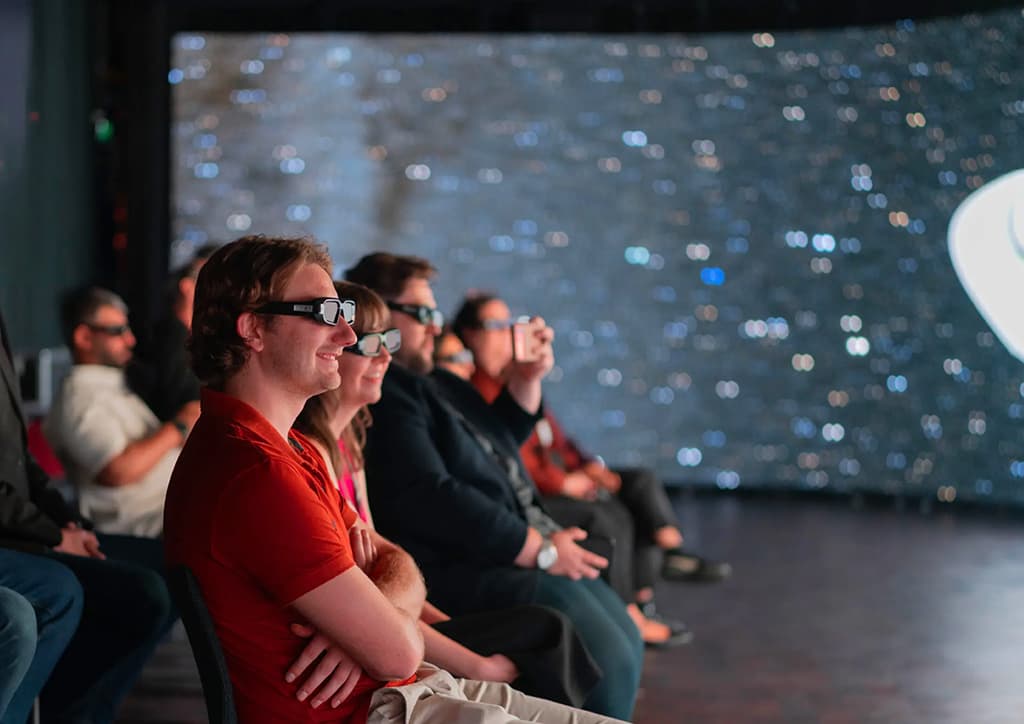
The display and shutter glasses combination provides a superior 3D experience.
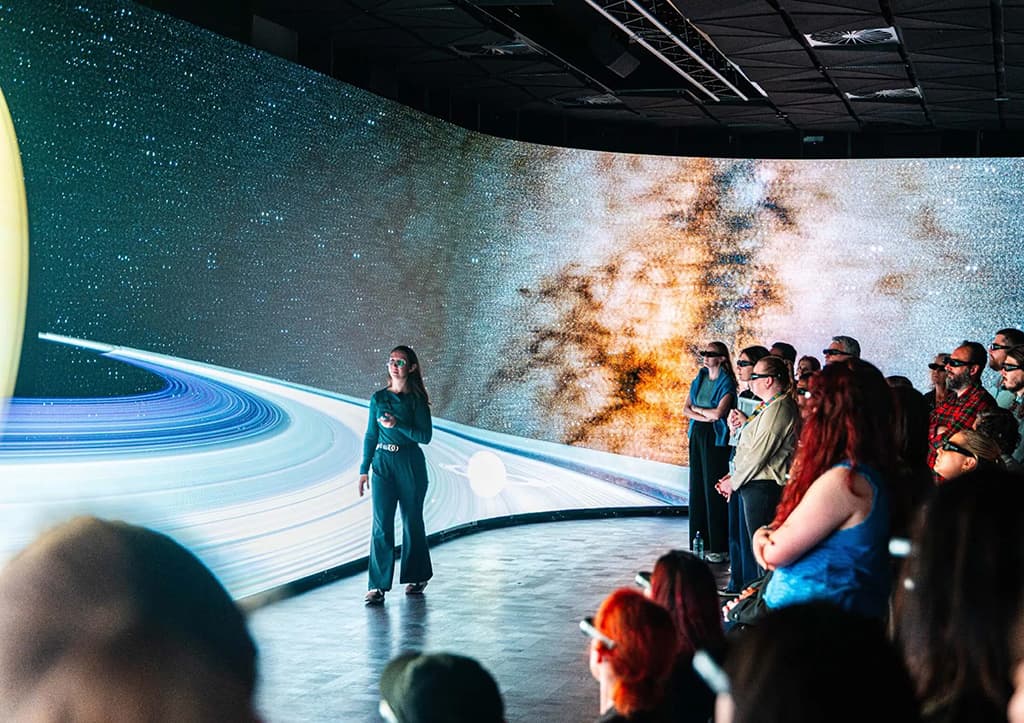
Dr Kirsten Banks keeps her audience captivated. The experience is shared, unlike VR.
Q-SYS STEPS UP
Q-SYS provides the AV backbone for audio, video routing and control, enabling seamless transitions across use cases. Matt Vance of Optimal Audio served as audio designer and primary Q-SYS programmer, also handling control interfaces and video switching.
The audio suite comprises 18 Q-SYS PL Series loudspeakers and seven companion subwoofers configured for both cinematic 7.1 immersive and presentation reinforcement. Spatial audio capabilities allow sounds to move dynamically through the space – rockets blasting past, birds flying around heads, or gravitational wave simulations derived from actual telescope data. “We can actually shake the room with the subwoofers,” a clearly-impressed Carl Knox noted. Careful voice lift zoning prevents feedback during presenter movement along the front corridor.
Video routing handles diverse sources including multiple laptops, cameras and the astrophysics cluster. Q-SYS VisionSuite AI-powered PTZ tracking follows presenters, with foldback and confidence monitors mapped flexibly. The system communicates with the NovaStar processor and supports future expansions. Control interfaces simplify operation via touch panels, automating backend complexity. “We really threw the kitchen sink at Q-SYS for all the systems that are involved here. From a user perspective, you can just choose a mode,” Matt Vance said.
Integration with Igloo Vision is particularly elegant. “If a laptop input has been pushed all the way to the right of the canvas we can take a control signal from Igloo Vision back into Q-SYS that allows us to move the audio image associated with that visual object,” Vance detailed. This creates audio localisation whether for multi-site video calls or dynamic presentations. Multiple modes – from basic plug-and-play to full clustered operation with voice control and live music – are realised without compromising usability or future creativity. “We’ve left everything possible. But trying to distil that down to a simple press a button and get a result was the challenge,” Vance acknowledged. “I don’t think any other platform could have achieved what we’ve done here with Q-SYS.”
Programmed Electrical Technologies – ably led by Anthony Aloi – managed the physical integration (as well as the AV integration) in a challenging architectural envelope with concrete pillars. It designed and installed a custom structural frame to millimetre precision, avoiding tension cables in the slab, while concealing speakers, microphones, cameras, trusses and services. “We jammed a lot of tech into the roof and at the end of the day, no one’s meant to see any of that,” Carl Knox said.

NICE CORE: THE POWER OF IGLOO
Igloo Vision was in on the conversations early, contributing to the technology exploration and tender evaluation, then delivered the Core Engine software that unlocks everyday usability on this hungry beast of a canvas. Traditional LED workflows are rigid; Igloo brings intuitive control.
“I think one of the challenges of such a large-format LED screen is making it flexible,” James Sheridan explained. Support extends to Office 365, Google Slides, web dashboards, game engines, immersive video and 3D models. A single media server drives the entire 20,000-pixel-wide stereo surface, handling up to 20 PIPs, webpages stretching to 16,000 pixels, and mixed stereo/3D content.
This capability proves transformative for a hybrid space. “People can come in and just drag and drop 3D models into the space. They can mix and match that with webpages, movies, up to five laptops on the screen at once,” James noted. Perspective-correct immersive content on the wings – challenging for conventional LED processors – combines naturally with other sources on the one canvas. The platform bridges expert astrophysics clustering (real-time navigation through massive datasets) with casual use by lecturers, students or commercial renters, ensuring the space’s use extends to, pretty much, anything you can think of – TED Talk-style lectures, musical recitals, art exhibitions etc.
“”
We really threw the kitchen sink at Q-SYS for all the systems that are involved here. From a user perspective, you can just choose a mode
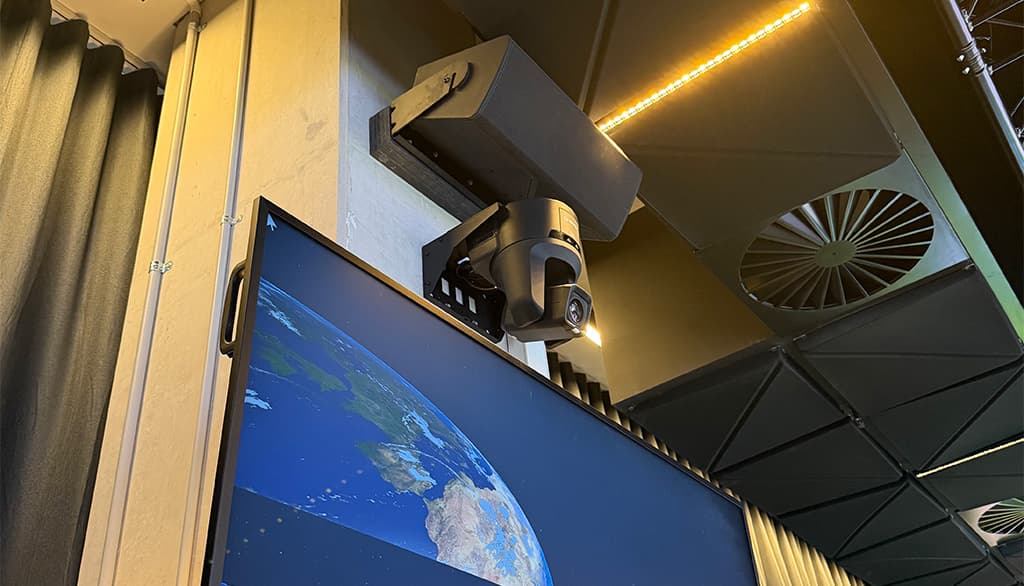
Q-SYS VisionSuite AI-powered PTZ tracking follows presenters, with foldback and confidence monitors mapped to suit. Pictured is the Q-SYS NC-Pro15X camera.
PRACTICAL MAGIC
The bespoke content prioritises scientific truth over Star Wars-style spectacle. “Everything we show here is either a true image from space or it’s derived from physical laws or databases,” Matthew stressed. The 1.8 billion-star Gaia Space Observatory dataset produces breathtaking visualisations; billion-particle galaxy simulations and black hole accretion discs reveal real physics. The custom clustered software, built on 25 years of making space content understandable, supports non-linear storytelling, voice-controlled digressions and library access. “It shouldn’t be like PowerPoint. I wanted it to be able to go on digressions. If a young audience looks a bit blank hearing about galaxies for the first time, we can instantly call up a gallery of amazing images of galaxies, that sort of thing,” Matthew said. Three genlocked machines with high-end GPUs (96GB RAM each) drive real-time performance after months of optimisation.
Dr Kirsten Banks, the astrophysics content lead in this space, provides some feedback around what it’s like to ‘drive’ the space: “It is so fun. This is the best office in the world. But I think what’s really awesome is that you really get to immerse yourself into space, which is something that you can’t do even as an astronaut. We can get up close and personal with some of the most dense compact objects in the cosmos, and explore their front, backside, top and bottom. And that’s a really powerful tool to help people not only be inspired by the universe, but also conceptualise the universe right there in front of their faces.”
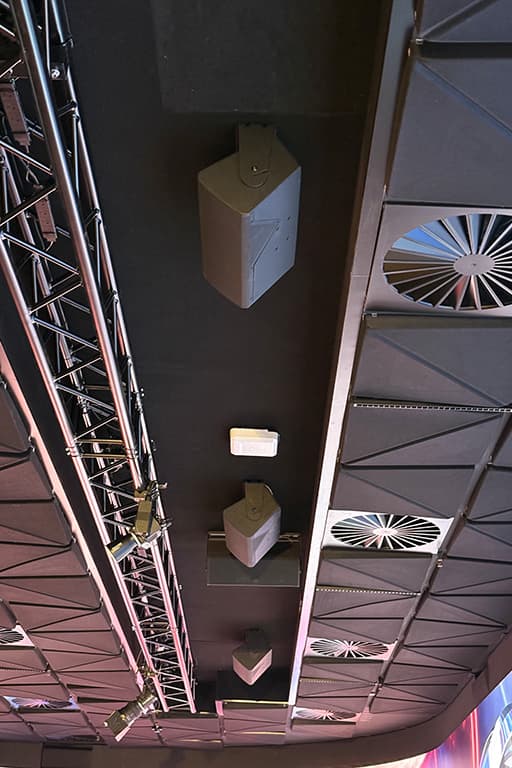
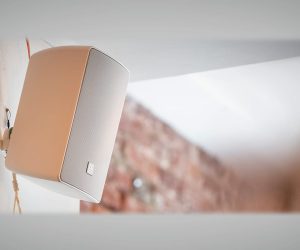
A few of the 18-speaker 7.1 Q-SYS PL Series (with seven companion subs) surround sound system.
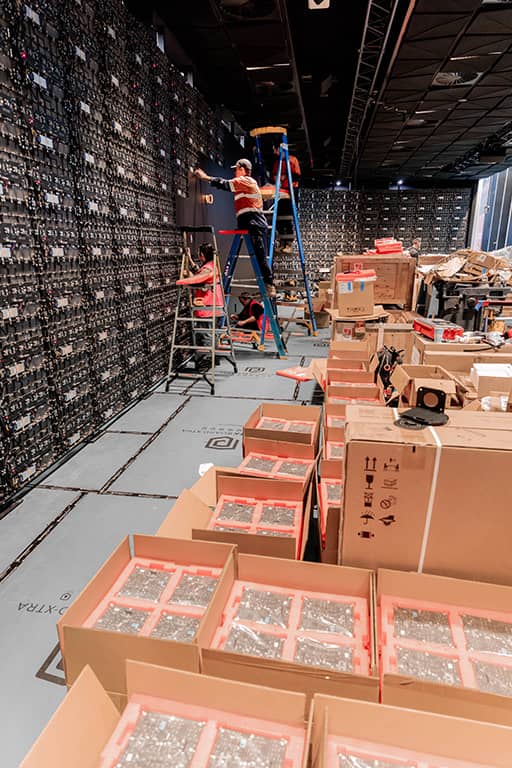
The Absen LED screen being built.
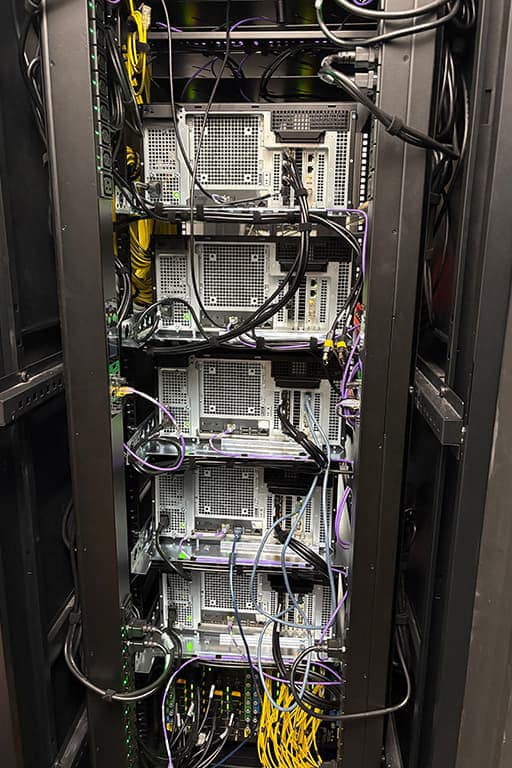
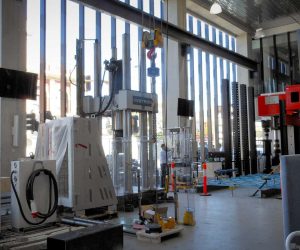
Some of the display processing.
MISSION ACCOMPLISHED
The technical challenges in realising the Virtual Universe were substantial: curved geometry, multi-computer genlock, input mode compatibility debates, and coordinating multiple teams in a confined space. Yet delivery felt seamless. “It was a fantastic team experience,” Matthew reflected. “We never once had anyone say, ‘look, you can’t do that.’”
Anthony Aloi from Programmed described the once-in-a-lifetime nature of designing the frame, coordinating unknowns like AI tracking, and witnessing the human impact. Carl Knox praised partners who bridged gaps beyond scope. The result instils pride around the uni and attracts researchers and students.
Remember the old Telstra Bigpond ad with the lovably clueless dad telling his kid the Great Wall of China was to keep the rabbits out? Back in the day, Matthew was that kid – lots of questions about the universe but few answers. So the payoff for him is big. “I want to take kids that were a bit like Matthew 50 years ago and provide them answers and show them that there is a scientific method.” Mission accomplished.
Swinburne’s Virtual Universe: swinburne.edu.au/research/facilities-equipment/virtual-universe
Programmed: programmed.com.au
Igloo Vision: igloovision.com
TAG (Q-SYS Australia): tag.com.au
Quantum Sphere (Absen): qsphere.com.au




RESPONSES