

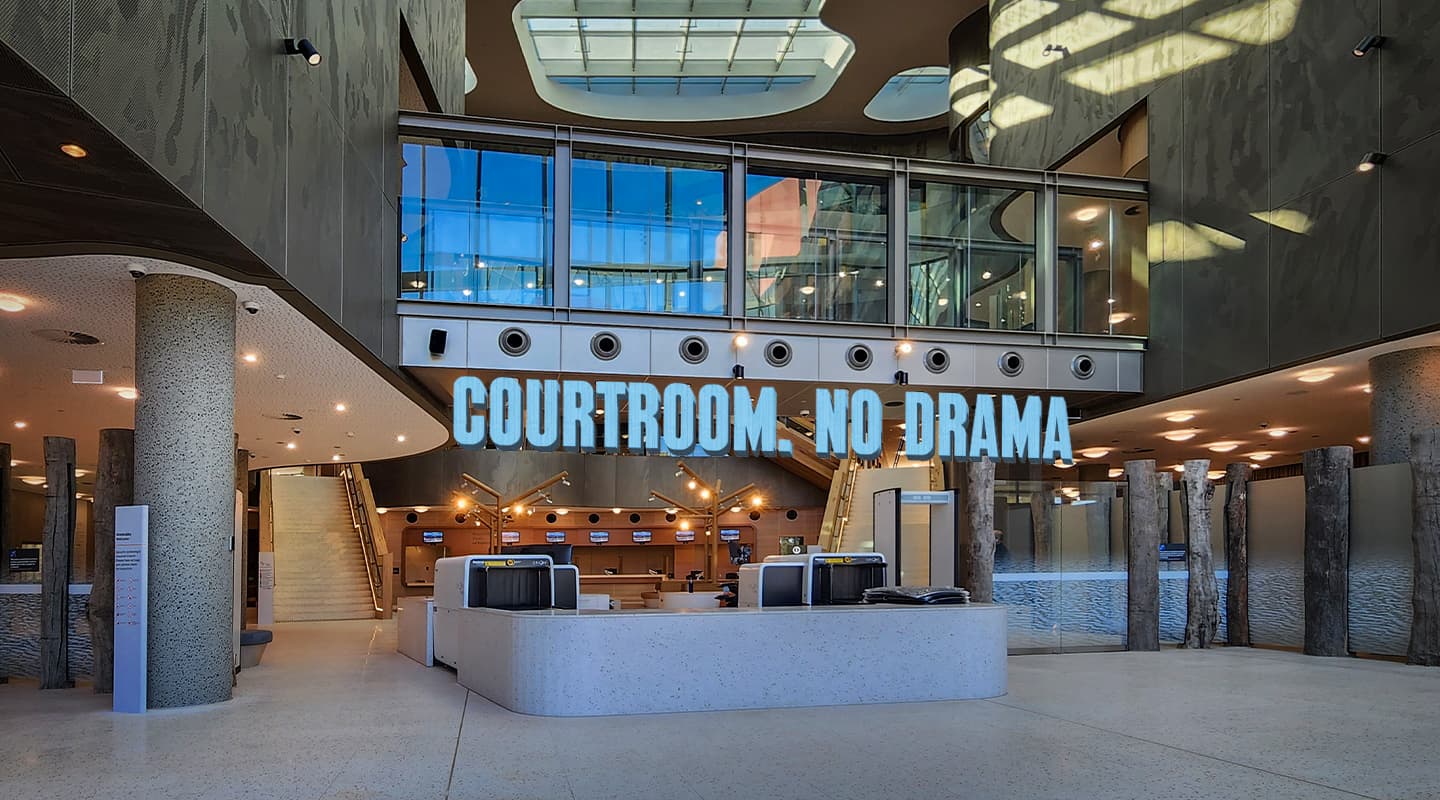
AV Case Study: Wyndham Courts
Umow + Wooster and Prime Technology Solutions win a richly deserved Judges’ Commendation in the 2025 Audio Visual Industry Awards (AVIAs) for work on this very modern and very complex courtroom complex.

13 November 2025
Text:/ Derek Powell
Photos:/ Courtesy Prime Technology Solutions
As court complexes go, the newly constructed Wyndham Courts complex on Melbourne’s western fringe was about as complex a development as you would find – a complex complex, you might say. The AV scope included: 13 multi-jurisdictional courtrooms with six different court types; four hearing rooms; three mediation rooms; five remote witness rooms; three remote witness holding cells; and more than 60 digital signage screens and kiosks. Added to that were myriad interview and meeting rooms, breakout spaces, lounge areas, and more. If that wasn’t enough, there was a 300-speaker paging system, 130-room booking panels and hearing augmentation systems.
This project also embodied new and different layouts for children’s courts and Koori courts as well as special provisions in some courtrooms to provide physical separation for vulnerable persons who might be called as witnesses in sensitive cases. To add to the complication, the whole project was being fast tracked in both design and construction leading to a formidable set of challenges for both the AV consultants and the integrators.
Meeting these challenges involved a serious commitment to physical prototyping during the design phase; detailed collaboration with architects and joiners; and some innovative strategies during installation.
UNDENIABLE PROOFS
The first phase involved physically laying out the new courtroom spaces as AV consultant Sean Wooster explained. “The architects, Lyons, had mock ups of a number of the standardised courtroom environments built up out at the Schiavello factory. Here, we placed mock ups of the technology, the cameras and screens, so the stakeholders, clerks, magistrates and judges, could come and test drive the environment. They could see the space and the relationships between the different people in the space, as well as the look and feel of the technology. That was the first step in co-ordination”.
More was to come, but first, with AV-over-IP decided as the fundamental architecture and more than 600 encoders or decoders in the mix, no one could afford to take equipment selection for granted.
“AVCT, the technology group within Courts Services Victoria, was very strong on standardising as much as possible, so they don’t have a mix of different vendor products across five different sites they’ve got to support,” Sean Wooster recalled. “We did some testing of other products at the time, and considered, on a number of fronts, Crestron NVX had to be the best value for money in terms of the performance it was delivering as well as the support from the company behind it.”

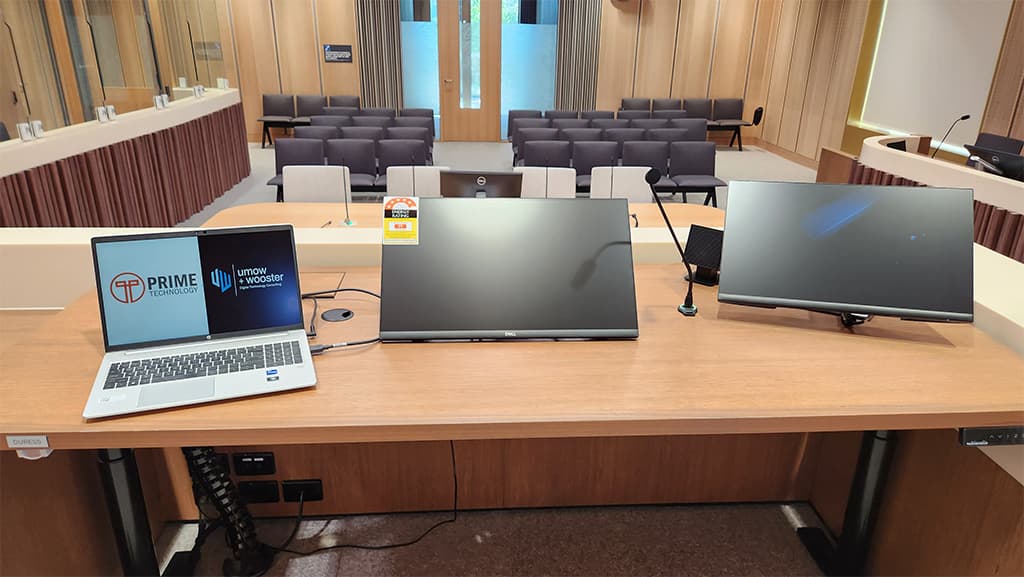
The Children’s Court showing the witness box, the bar table in front of the bench and the dock.
SYSTEMS PROTOTYPING
With detailed design progressing, the AV prototyping moved to integrator Prime Technology Solution’s own facility in Fairfield. “We actually built a fully-functional mock-up courtroom off site,” Andrew Hicks, Prime’s director recalled. “About 15 to 20 people from Court Services Victoria came to the facility to test drive the prototype, which was well before construction on site. The intent was to try and resolve the automation, that is the user functionality side, as much as possible in the prototyping stage. And it also meant we could test out compatibility between hardware products as well.”
With a project that introduced so many new concepts to the courtroom systems, this process proved most valuable, as Sean Wooster confirmed. “Several workshops were held, stepping through the pages in the Crestron control system,” he noted.
During the process, several complicated new functions, such as the use of the new vulnerable persons (VP) witness box, were able to be worked through in advance. To cater to this from an AV perspective, a duplicate set of cameras was required to allow the same sightline principles to be applied.
“That wasn’t part of their standard control setup,” Sean continued, “so we had to come up with a new page or a new button to enable that functionality, and then talk about exactly what happened under those scenarios.”
The solution adopted was to provide the clerk controlling the system with a single button which selects either the witness stand, or the VP witness stand. While that is a simple selection for the users, behind the scenes the AV system has to reconfigure to switch cameras, microphones, speakers, monitors, annotation, and so on.
“And of course, sometimes it’s not a single button,” Sean explains. “Sometimes there are many other elements that they want to control beyond just changing from one mode to the next. Stepping through all of those different pages and the layouts of the buttons on the screen streamlined a huge amount of that management process well in advance of when it was rolled out at the back end into the courts.”
“One thing that is unique, is that most of the courtrooms can operate in multiple different jurisdictions,” Andrew explained. “When you turn the AV system on, you select which jurisdiction to operate in. That could be as a Magistrate’s Court, a Children’s Court even as an Administrative Appeals Court. Catering to different jurisdictions within the one system made it quite complex, especially from a user interface perspective.”
“”
Their offsite AV build approach was genuinely ground-breaking and a key factor in keeping the project on schedule

PRE-BUILDS & PROBLEM SOLVING
Modern courtrooms are now crammed with equipment to allow everyone to hear and see clearly what is being said, to examine and annotate evidence, and to faithfully record everything that happens. Housing all the equipment, keeping it out of sight, yet ventilated and accessible for service, is perhaps the most vital and the most complicated aspect of the detailed design planning. It is also the area where this project kicked some major goals – and won them praise from the client and the AVIAs judging panel. Let’s look at just two examples, among many, where forward thinking paid off.
MORE THAN A PRETTY SHELF
Each of the courtroom PTZ cameras connects directly into a Crestron NVX encoder unit to integrate them into the backbone AV-over-IP system. Since they need to be close to the camera, which is often high up on a wall, the housing of these NVX units is often a challenge, as is finding an elegant support solution for the cameras themselves.
Knowing this, Prime got in early and worked with the architect to develop an elegant, custom-made camera shelf that not only supports the PTZ camera but also has a ventilated compartment within that houses the NVX unit and hides its cable connections. The solution is a very integrated and clean approach which is unobtrusive, yet enables easy service and support.
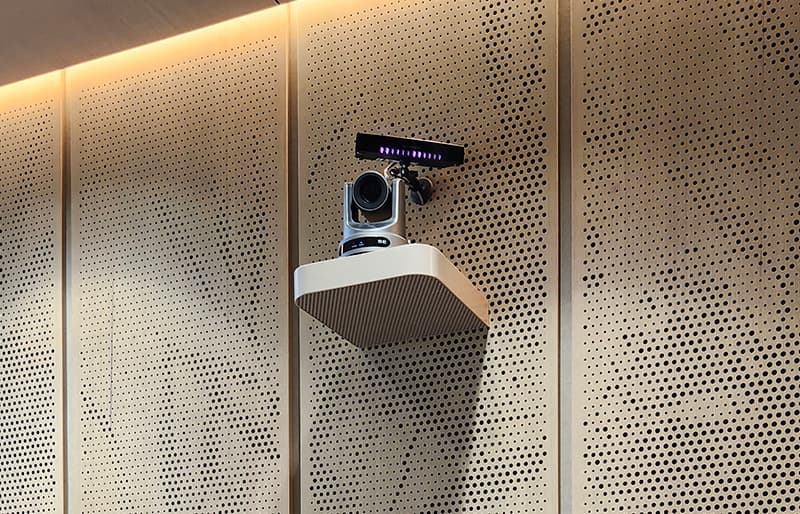
The apparently simple mounting shelf for the PTZ camera held a hidden compartment, ventilated from below, that contained the Crestron NVX encoder.
BRINGING IT HOME
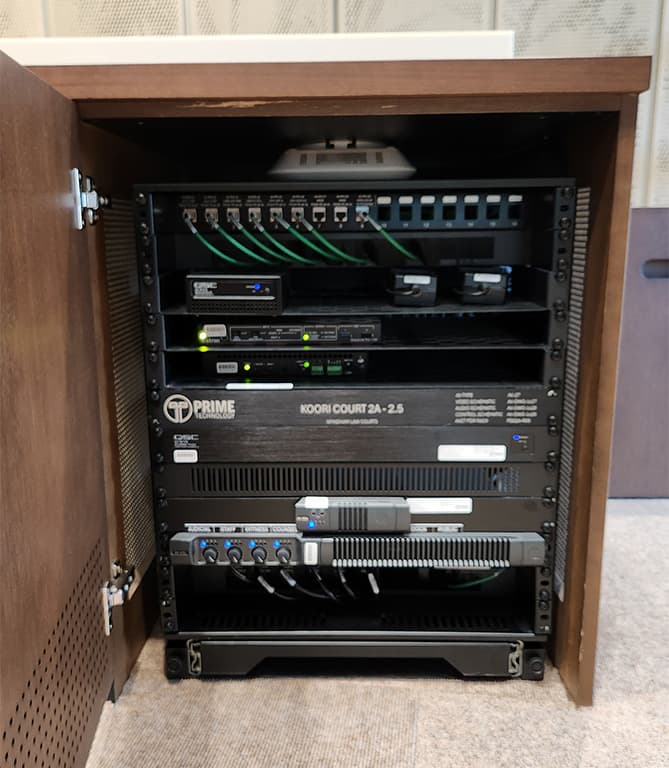
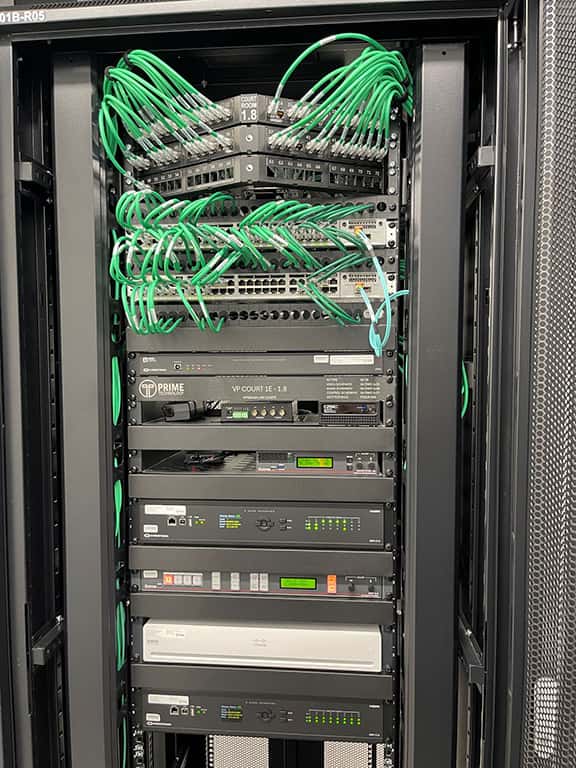
It is not uncommon for equipment racks to be pre-built and wired prior to delivery to site but for this project Prime took the concept of pre-building much, much further. Equipment destined for mounting in joinery such as under the bench, in the bar table, or in the witness boxes, was prebuilt off-site on custom mounting boards. While it sounds simple, getting pre-built modules to simply slot in where they need to go requires detailed planning and close co-ordination between architects, consultants, the joinery team and the integrators.
“Mounting of the equipment was certainly one of the finer details of the project,” Andrew Hicks revealed. “We had a lot of coordination with the joinery design company, and with joinery manufacturers to cater to the sizing. position of power and data; and ventilation as well. There were modifications done to some the joinery at our request. For example, a support leg for one of the cupboards was designed to be removable, so that we had the space to actually insert our pre-built mounting board.”
“It was really around getting that level of detail and integration into the joinery,” agreed Sean Wooster. “[Otherwise] at the back end of projects, quite often you find that you’ve got problems with cable management, thermal management, and you’ve got problems with ongoing access for maintenance by the operations team.”
“On this project, we’ve seen the results from many, many workshops, both in design and delivery with architects, builders and designers sitting down and working all of that out up front,” Sean continued. “It’s allowed this whole modular approach and resulted in probably one of the best looking and most serviceable installations and that I’ve been part of in my career.”
The payoff came during the crucial period as the builders completed each of the courtrooms. The pre-built, pre-wired and configured modules enabled the on-site AV installation time per courtroom to be slashed from typically two weeks for a three- or four-person crew to under two days for just three installers.
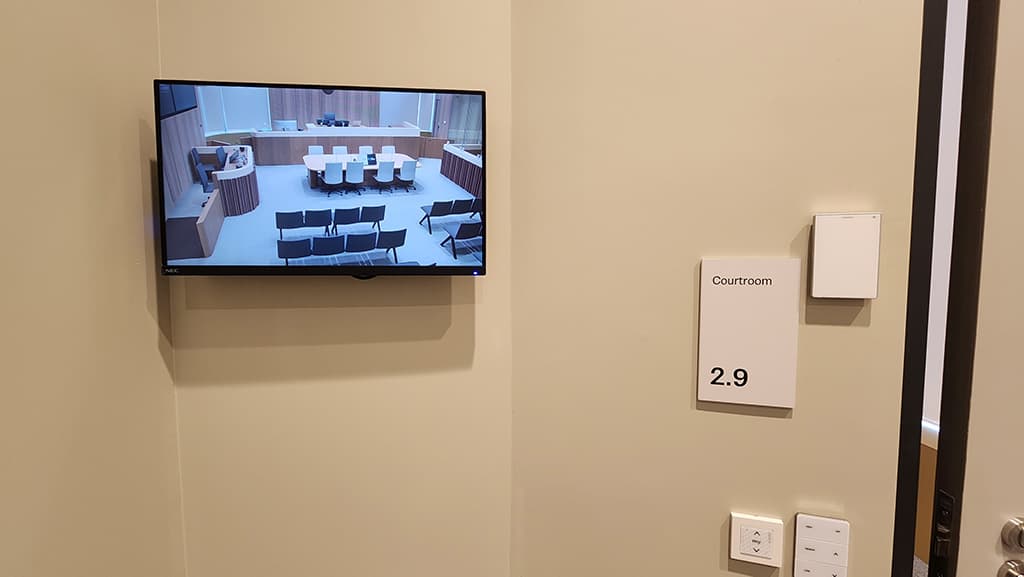
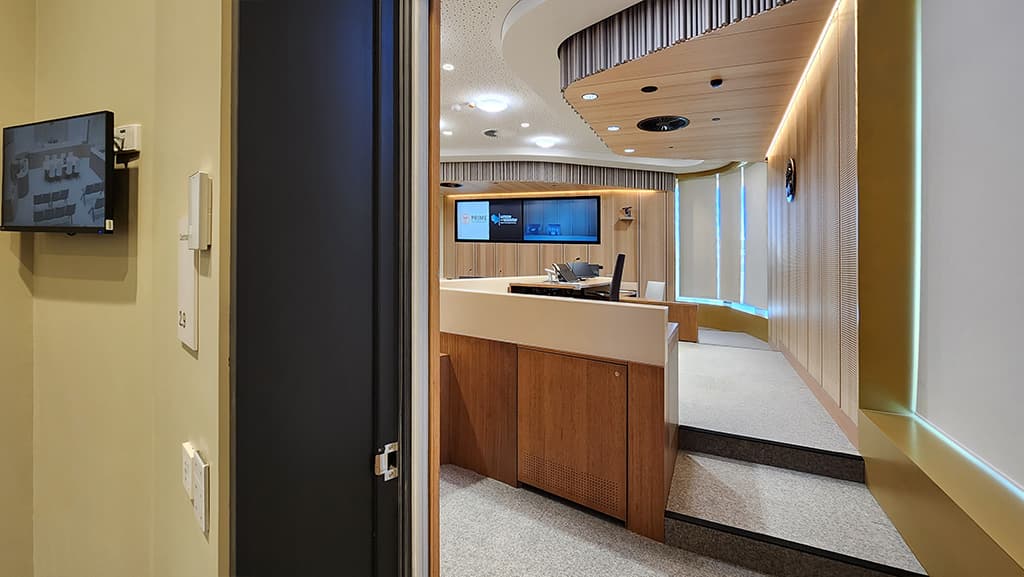
As an added layer of security, a monitor outside the staff entry to the courtroom displays what is happening within. A magistrate, judge or other staff member can thus check there is no disturbance or threat in the courtroom prior to unlocking the door and entering the courtroom.
COURTS IN THE ACT
The results were certainly not lost on the client, with Shane Berry, Technology Transition Manager for Court Services Victoria, offering the following comments to our AVIAs judging panel:
“Prime’s work has been exceptional. Their offsite AV build approach was genuinely ground-breaking and a key factor in keeping the project on schedule. Their attention to detail was excellent, their custom approach impressed, and they showed a clear understanding of stakeholder needs throughout. They collaborated seamlessly with the project and AV teams, which helped navigate the complexities of the build.”
You could hardly ask for a better commendation, and our panel agreed, awarding a thoroughly deserved Judges’ Commendation to consultants Umow + Wooster and the Prime Technology Solutions team.
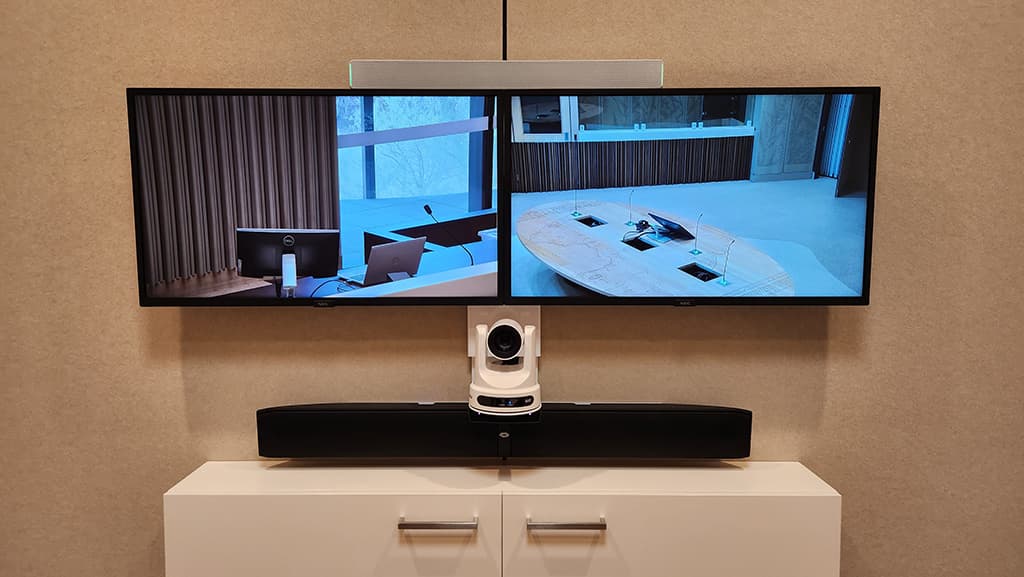
Witnesses can give testimony to hearings taking place across the state and beyond from the five remote witness rooms within the Wyndham complex.





RESPONSES