

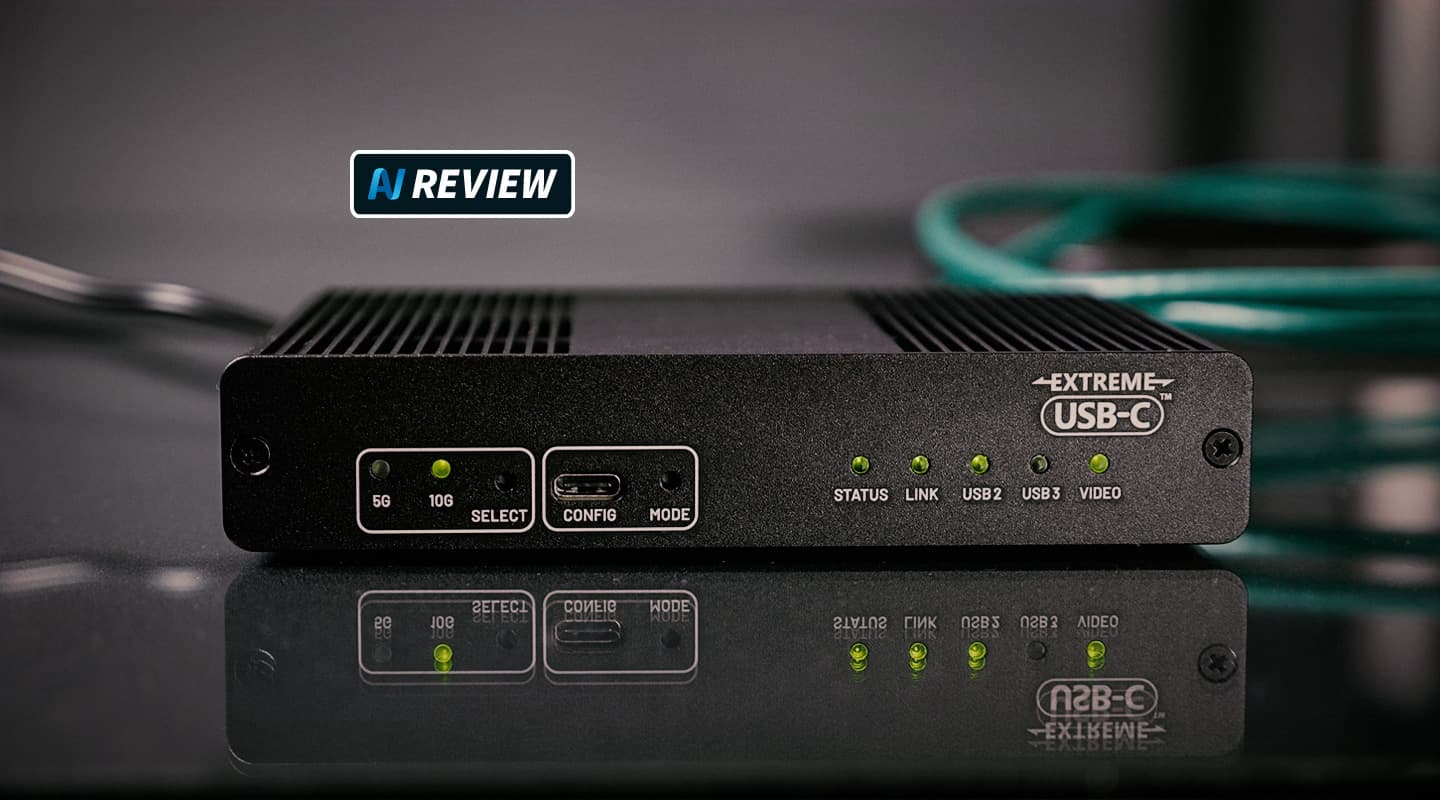
Review: Icron Arbutus 63301
A point-to-point USB extender offering up to 100m of distance over Cat6.

30 July 2026
USB-C has become a victim of its own success. It’s neat, convenient and genuinely useful, which means clients now expect it to do things it was never really designed to do. “Can’t we just run a single USB-C cable from the table to the display?” Sure. How far away is the display (once you run it neatly under the floor and walls)? “Oh, about 25 metres.”
Right.
At this point, if you’re not swimming in a native AV-over-IP environment, you’re looking for a workaround. Maybe the signals get split apart. Maybe there’s an HDBaseT system involved. Maybe a dock appears somewhere in the signal chain. And maybe USB starts behaving oddly the first time someone plugs in a conferencing camera.
Or maybe you use something like the Icron Arbutus 63301.
Now, to be fair, there are plenty of ways to extend USB and video around a building. In the point-to-point category, HDBaseT still makes enormous sense in plenty of applications. Optical USB-C cables can be a tidy solution. USB-over-IP has its place. Horses for courses. But the Arbutus does occupy a fairly unique corner of the market because it tackles a very contemporary AV problem in a particularly elegant way.
THE ONE-CABLE PROMISE
The appeal of USB-C is obvious. One cable for video, USB peripherals and a bit of charging. Walk into the room, plug in the laptop and everything just works.
The problem, of course, is distance. Native USB-C is perfectly happy across a desk but considerably less enthusiastic once you start talking about real-world commercial AV distances.
The Icron Arbutus approach is fairly straightforward: preserve that native USB-C experience across 100 metres of standard Cat6a infrastructure.
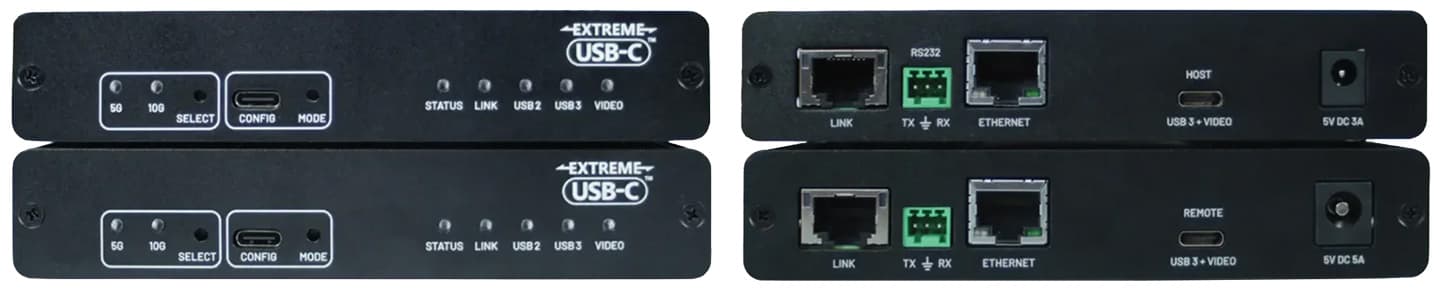
The system consists of a Local Extender (LEX) and a Remote Extender (REX). One lives near the source device, the other at the display and peripheral end. Between them is a single Cat6a cable. No fibre termination. No network switch. No software drivers. Just a point-to-point extension system.
At the user end, it still behaves like USB-C. Plug in a single cable and you’ve got video, USB and some power delivery all happening together.
And importantly, all happening properly.
NOT JUST VIDEO WITH ‘A BIT OF USB’
This is where the Arbutus starts to distinguish itself from some of the alternatives. Quite a few extension systems treat USB as secondary to the main game. Keyboards and mice work fine but once you introduce conferencing cameras, DSPs, touchscreens or audio interfaces things can become less predictable.
The Arbutus supports all four USB transaction types, including isochronous traffic – which real-time audio and video devices rely on. In practical terms, that means USB peripherals behave much more like they’re directly connected to the host machine.
That might not sound especially exciting on paper, but it’s often the difference between a room that quietly works every day and one that develops mysterious faults.
The hubless topology is another important detail. The host PC doesn’t see a stack of USB hubs sitting in the path, which matters more than you might think in enterprise environments where certain devices and drivers can become quite particular about hub tiers adding up.
4K THAT LOOKS RIGHT
The Arbutus supports DisplayPort Alt Mode video up to 4K/60 with 4:4:4 chroma sampling. And yes, ‘4K’ can be a rubbery term, but 4:4:4 still matters — particularly in corporate and education environments where the display is mostly spreadsheets, browser tabs and tiny fonts, or in medical applications where detail and accurate colour is critical.
We’ve all seen systems where fine text starts looking slightly mushy once compression and chroma subsampling enter the picture. Here, text and UI elements stay crisp and readable. It behaves much more like a direct connection than a heavily processed transport system.
And it’s doing that while simultaneously carrying USB 3.2 Gen 1 traffic over the same Cat cable.
Again, horses for courses. There are fibre systems capable of higher bandwidth. There are AV-over-IP platforms that scale more broadly. But there’s something refreshingly uncomplicated about the Arbutus approach. No switch configuration. No multicast management. No dependency on network infrastructure. It’s simply a dedicated point-to-point link.

WHERE IT FITS
You can immediately see the kinds of applications this product suits: large classrooms, boardrooms, courtrooms, medical spaces, overflow presentation areas… Anywhere the peripherals and displays live a long way from the user position but the expectation is still for a seamless USB-C experience. Particularly now that BYOD workflows are becoming standard almost everywhere.
The other thing worth noting is what disappears from the design. No separate docking station. No standalone USB extender. No additional HDMI transport. No awkward collection of cables emerging from the table box. One CAT cable between two compact units replaces what could otherwise become a fairly messy multi-vendor signal chain. Integrators will appreciate that.
SMALLER DETAILS THAT MATTER
There are a few less glamorous details here that are worth mentioning. The REX can provide up to 15W power delivery to a connected USB-C device, which is enough for touchscreens, small signage players and similar peripherals without needing another local power supply.
There’s HDCP 2.2 support onboard, along with EDID management and MCCS pass-through for display control.
And for government and defence projects, DAHL approval will be relevant.
Physically, the units feel reassuringly commercial-grade – compact aluminium enclosures that look designed for installation.
THE BIGGER PICTURE
What makes the Arbutus interesting isn’t that it individually solves video extension, USB extension or docking, it’s that it combines all three while still feeling straightforward to the end user.
That’s the challenge, after all: preserving the simplicity people expect from USB-C devices once the realities of room design and cable distance get involved.
The closer a system behaves to a direct cable connection, the better the user experience tends to be. And the Icron Arbutus gets us pretty darn close.
MadisonAV: madisonav.com.au





RESPONSES