

AV Case Study: High Court of Australia
A comprehensive refit of the AV systems in Australia’s highest court by Intravision took out the AVIA in the hotly contested Government category. We take a deep dive into the backrooms of our justice system to explore their newest update.

17 October 2025
Text:/ Derek Powell
Photos:/ Courtesy Intravision
Much has changed in the 45 years since the High Court building was opened in 1980. AV systems are now crucial to the operation of our justice system by enabling evidence to be more clearly presented, allowing remote participation in hearings, and the capture of proceedings. The latter is particularly important to the High Court where video recordings of the proceedings of the Full Court are made available for any member of the public to review.
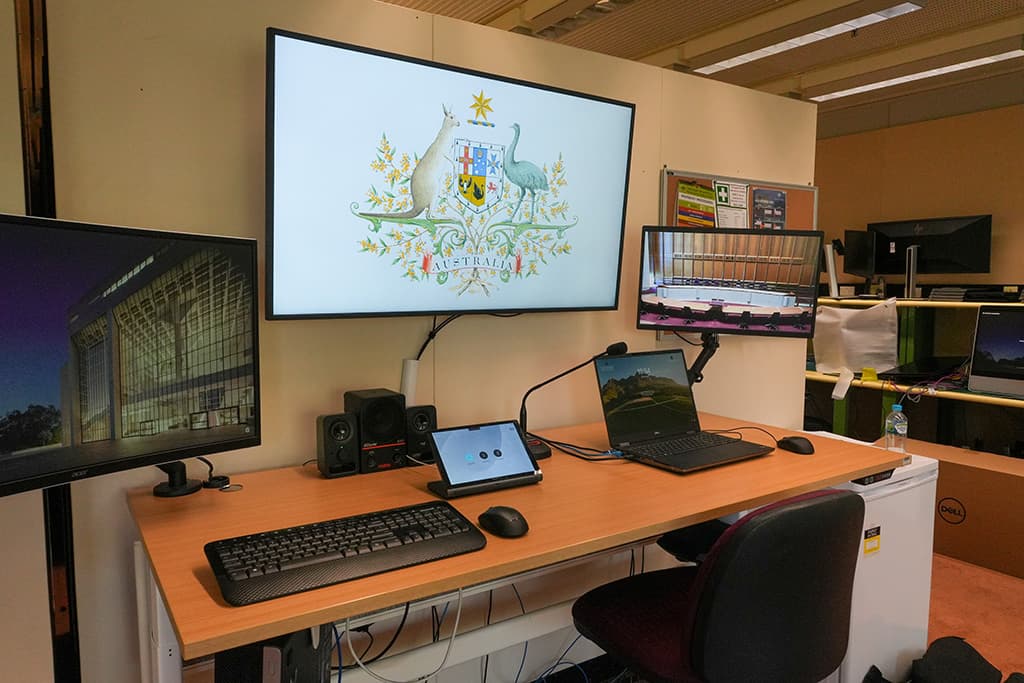
Intravision was engaged as the principal AV contractor for the High Court of Australia’s major courtroom technology upgrade. Based on a brief from the High Court and functionality requirements developed in consultation with acoustic and AV specialist For the Record, Intravision’s responsibilities extended well beyond installation. Its role encompassed design refinement, systems engineering, supply, configuration, commissioning, programming, testing, and stakeholder coordination across three fully operational courtrooms, and two back of house control desks within this nationally significant, heritage-listed building.

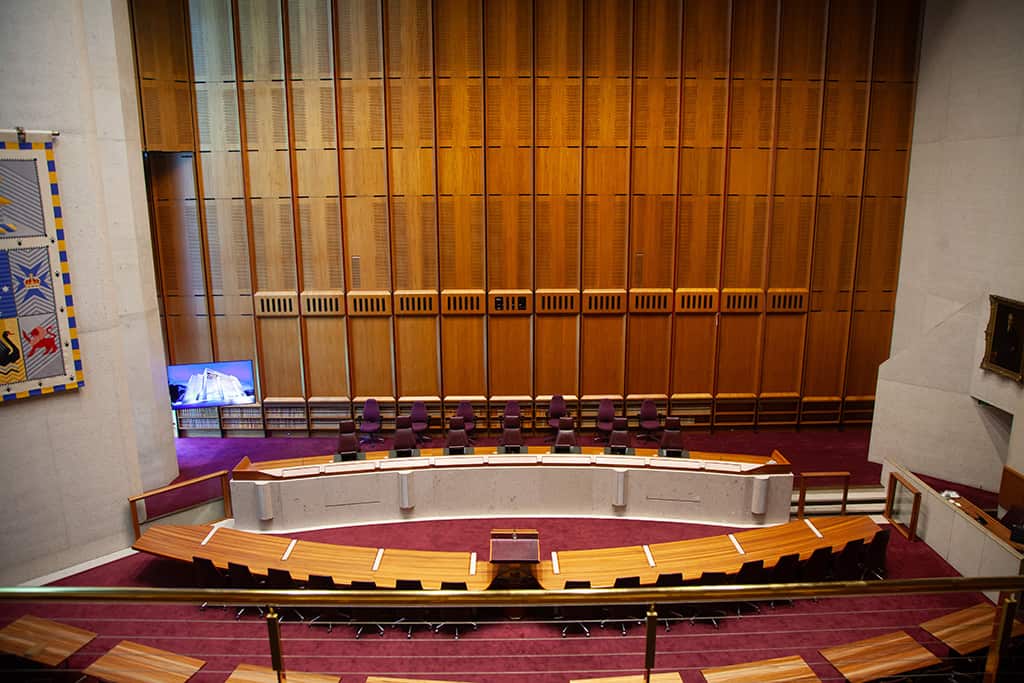
In Court One, home to full bench hearings, concealed cameras and voice lift speakers have been invisibly replaced, and a slide out monitor added to enable remote participants to be seen.
RE-WIRING AN ICON
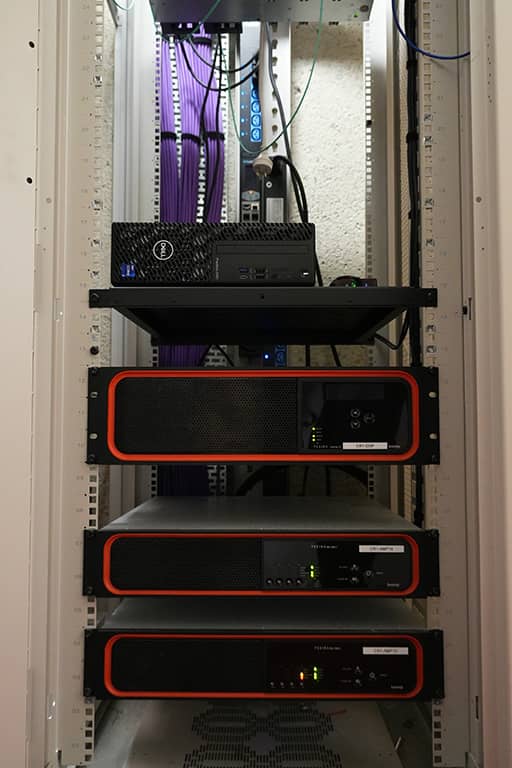
The basis for much of the AV infrastructure upgrade was a transition to AV over IP. This encompassed a comprehensive rewiring of the court’s network systems, a task well suited to the expertise in Intravision’s Communications division, but one that was quite challenging nonetheless given the building’s architecture and heritage status. Existing network equipment and wiring first had to be renewed before a comprehensive re-cabling and replacement of the audiovisual equipment.
Dave Hobson, Intravision’s Senior AV Engineer, ran through some of the IT details: “The network forms the central component of the detailed AV system design,” he recalled. “Part of our engagement was to remove the existing AV and network cabling, and all the existing AV equipment, before re-running the new fibre and copper cabling required by the new system. The cabling was a substantial component of the new system, and many cable path challenges were overcome throughout the project.”
Given the complex architecture, this was no mean feat. Replacing the fibre backbone involved accessing existing paths in tunnels, through cable risers concealed within the building columns and adding new structured cabling from the various racks for Courts 1, 2 and 3. To complete the transition to AVoIP, Intravision added more than 200 new Cat6a outlets to service the ethernet and PoE hardware throughout the systems.
“Networked AV is everywhere now,” Dave continued. “I would say around 80% of our systems these days exist around a network switch, as opposed to a traditional video or presentation switcher. If you don’t have the skills to install and test network infrastructure, and configure the network, you’ll struggle with modern AV systems. Another challenge comes when the AV system must exist on the client network, because we lose control of the network configuration, and sometimes access to the equipment. We generally guide the client through the required network configurations which can be challenging as they sometimes don’t have experience with networked AV, and multicast in particular.”
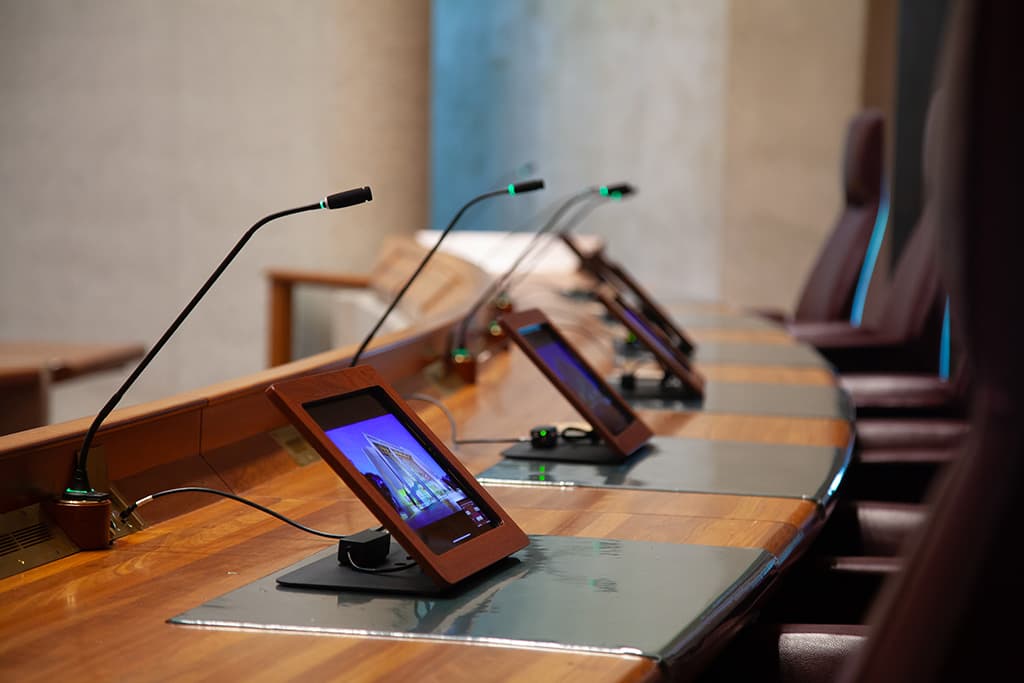
Apart from the extensive cabling aspects, the project involved three main sub-systems. 1. The video element, which required replacement of all the discreet cameras that record proceedings, and the addition of videoconferencing to enable remote participation in hearings. 2. The audio system, which included replacing most of the ageing speakers that provided discrete voice lift and foldback across the courtroom spaces. And lastly, 3. the addition of an AV control system that would allow a central IT desk to set up and monitor the complex systems to suit the requirements of each court sitting. Each brought its own special challenges.
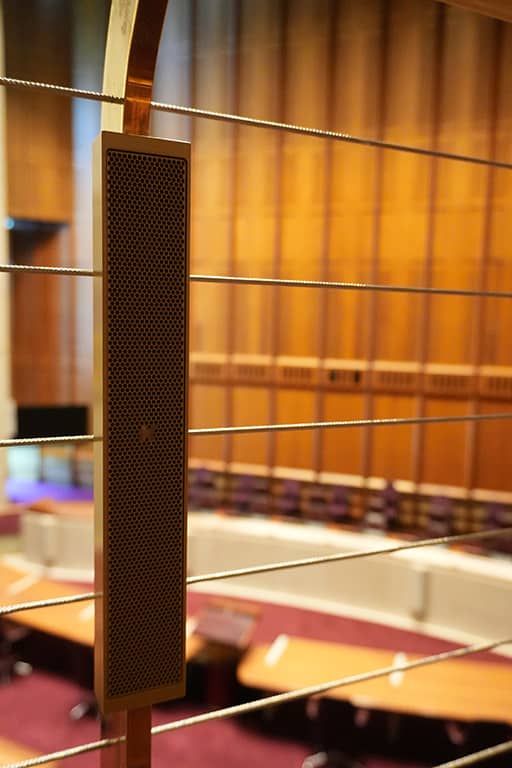
The new K-Array speakers on the gallery handrails have been custom built with a brass finish, while special care was taken to conceal the wiring.
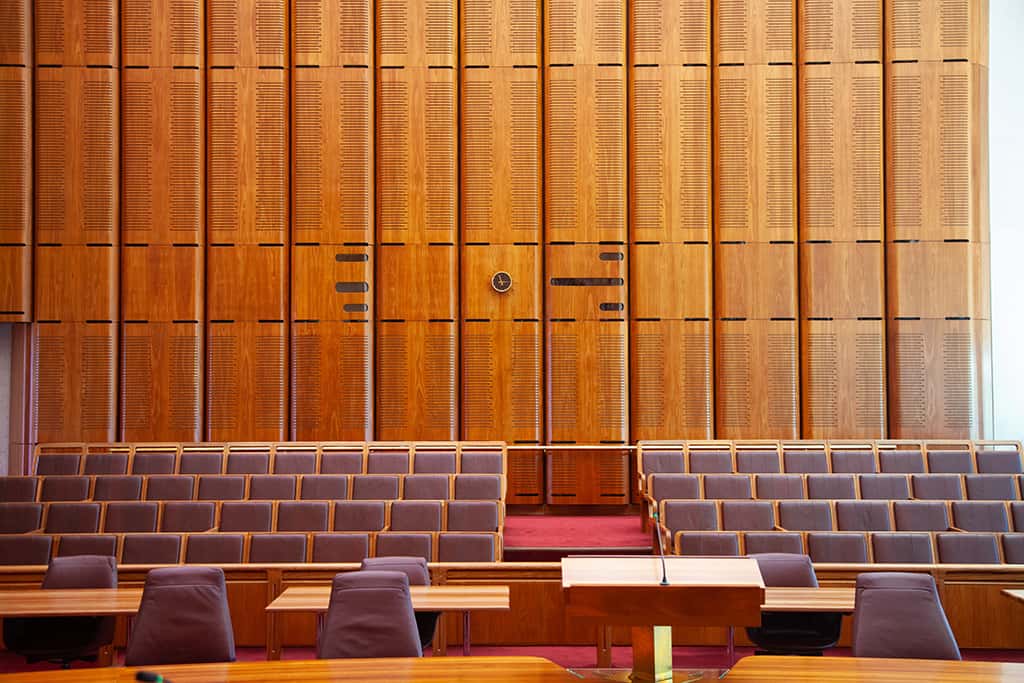
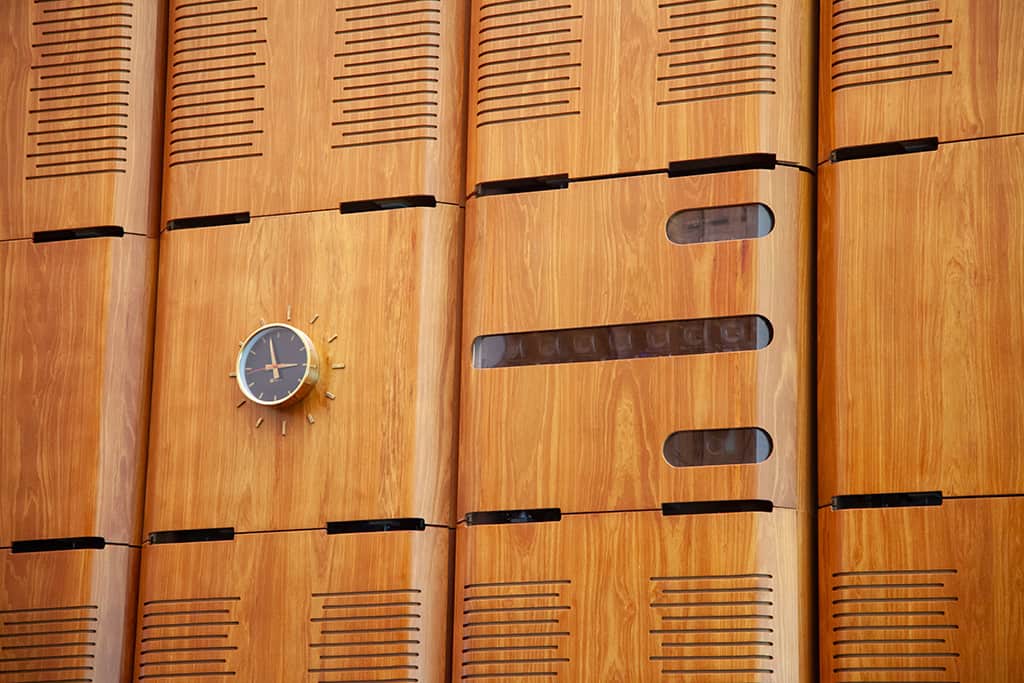
A combination of Marshall block cameras and Panasonic PTZ cameras, used for recording and videoconferencing, are kept as unobtrusive as possible behind Perspex in the red tulip oak timber panels.
AUDIO: TOP BRASS
The voice lift systems, especially in the largest chamber, Court One, is extremely specialised having famously been designed decades ago by Glenn Leembruggen with the competing goals of keeping speakers concealed within the architecture while providing even coverage in a challenging acoustic. Replacing the worn-out speakers and ageing amplifiers was complicated by the need to find components that actually fit the pre-existing locations and could be trimmed to blend in with the updated interior finishes on which they were mounted.
Dave Hobson detailed some of the challenges. “The main portion of the upper gallery was covered with small form factor K-Array speakers which were discreetly mounted to the brass hand railing along the front of the upper gallery. The speakers were ordered in a custom colour to match the brass, and the cabling was concealed within brass covers to match the railing upright, and within timber trims along the top of the horizontal concrete section. Even the terminations were challenging as there wasn’t enough space to bring two cables to the speaker for the parallel wiring, instead a single cable for each speaker was soldered to the main line in the also very small space within the timber trim.”
The upgrade extended to the replacement of the speaker drivers in the novel array of speakers located in the Associates’ area, just behind the Judges seats. (The Judges’ Associates assist the Justices during hearings). These speakers, hidden in the joinery, provide the audio coverage to allow these staff to hear proceedings clearly. However, as they are located directly behind the open Judges’ microphones, careful tuning is required to avoid feedback into the judges mics. “Those speakers were built into the custom joinery,” Dave noted, “We disassembled these joinery sections to install the new speaker drivers which wired back to new PoE amplifiers within the judges bench joinery.”
“”
The project demonstrates an impressive harmony between modern technological integration and the traditional architectural character of the High Court, supported by a high standard of installation execution
KEEPING HERITAGE INTACT
Adding extra cameras to record the hearings proved tricky for a different reason. A request to extend a Perspex window in the back of Courtroom 2 initially faced pushback on heritage grounds.
“There wasn’t enough suitable space for the seven new cameras within the existing ‘camera windows’ at the rear of court two” Dave recalls. “We had to demonstrate that simply locating the cameras in the available spaces would result in a non-ideal outcome as the perspective view of each judge would come from a different angle. The high court agreed, and a modification was made to one of the timber panels to extend a single window right across the panel to accommodate all seven cameras together. Camera alignment was really tricky as the only option was to install them within the panel itself. When the panel is hinged open, the cameras are not in their correct position. So I had to quite awkwardly insert myself into the tiny wall cavity, close the panel, and align the cameras while looking at each camera’s output on a laptop being held up in front of the window (which was full of cameras making it hard to see out). A couple of hours felt like a couple of days, and I was pretty happy when I was actually able to climb out which was also quite a challenge.”
STAYING ON SCHEDULE
Not the least of the hurdles faced was the timeframe. The High Court operates year round and to immovable schedules determined well in advance. This demanded tight coordination, flexible resourcing, and absolute precision to ensure the court’s processes were never disrupted and that future dated hearings and sittings could proceed without delay. That coordination involved everything from requesting artwork be removed temporarily to having the precious carpets lifted to gain access to cabling channels underneath.
“The High Court were a great client to work with,” Dave Hobson declared, “That said, it was still an intimidating time frame to complete the project. What worked really well for us was running two teams on site. We had an excellent crew of cablers from our cabling division which did an outstanding job on the cabling, and also jumped in and helped with the AV install. And our AV install team who also did an amazing job with the fitout. All our install staff on site had the required skill sets to complete the installation on time. In addition to this, the install team were provided with a very good set of engineered ‘issue for construction’ detailed schematic drawings which ensured full understanding of the installation requirements from the get go. Without good detailed drawings a lot of time can be lost with the install team chasing information. Equipment configuration was handled offsite prior to install, so there was less to deal with at ‘crunch time’. The commissioning and programming phase was again challenging due to time frame, but we managed to deliver the completed system on time.”
THE SUMMATION
In summing up their winning entry, the AVIAs judges applauded Intravision’s meticulous pre-planning and attention to detail in overcoming the difficulties of working around the busy court schedules. They commented: “The project demonstrates an impressive harmony between modern technological integration and the traditional architectural character of the High Court, supported by a high standard of installation execution.”
More pertinently, perhaps, the client clearly agreed, with the High Court’s Chief Information Officer, stating: “This project presented a unique set of challenges, not least of which was working within a heritage-listed building of national significance. Intravision approached the task with a deep respect for the architectural and historical importance of the site, ensuring that all works were sympathetic to the original design and heritage requirements.”
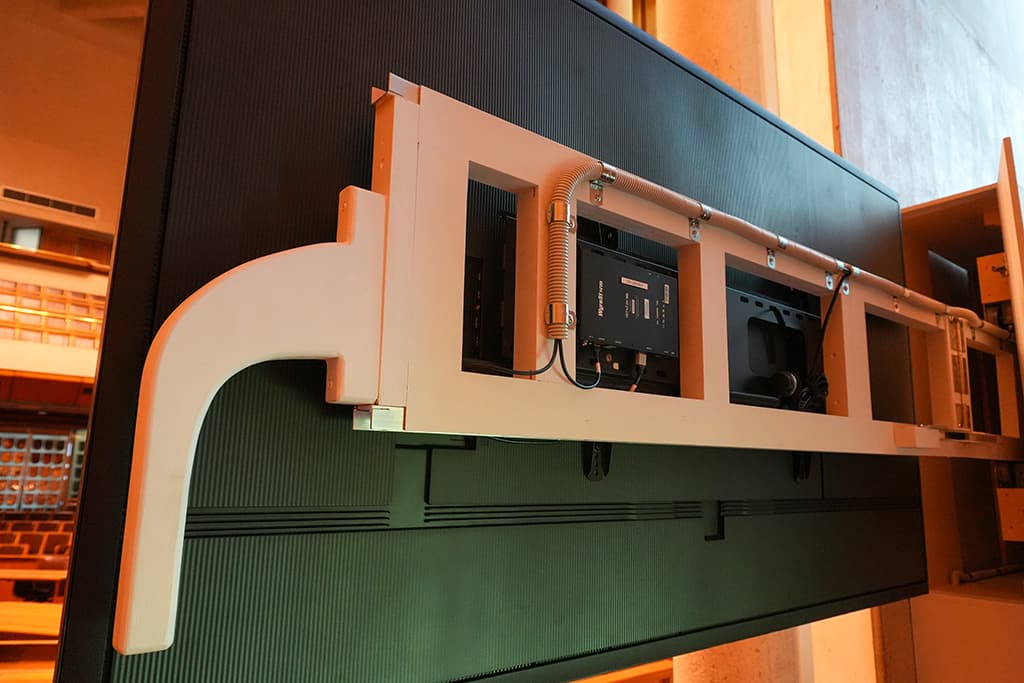
A concealed slide arm allows the far-end videoconference 85-inch monitor to disappear into the wall when not required.










RESPONSES